

2026 Updated Verified Pass Salesforce-MuleSoft-Developer-I Exam - Real Questions and Answers
Dumps Moneyack Guarantee - Salesforce-MuleSoft-Developer-I Dumps Approved Dumps
NEW QUESTION # 135
Refer to the exhibits.

The my-app xml file contains an Error Handier scope named "global-error-handler" The Error Handler scope needs to be set to be the default error handler for every flow in the Mule application Where and how should the value "global-error-handler" be added in the Mule project so that the Error Handler scope is the default error handler of the Mule application?
- A. In the my-app.xml file, as an attribute of a configuration element
- B. In the mule-artifact json file, as the value of a key-value pair
- C. In the Validation folder as the value of a global element in the error-handling yaml file
- D. In the pom.xml file, as the value of a global element
Answer: A
NEW QUESTION # 136
Refer to the exhibit.
This RAML specification includes a resource and method to retrieve accounts by account_type and industry.
What is the correct URI to get all retail finance accounts?
- A. /accounts?account_type:retail&industry:finance
- B. /accounts/account_type=retail/industry=finance
- C. /accounts?account_type=retail&industry=finance
- D. /accounts/retail/finance
Answer: C
Explanation:
Correct answer is /accounts?account_type=retail&industry=finance
Query parameters are a defined set of parameters attached to the end of a url. They are extensions of the URL that are used to helpdefine specific content or actions based on the data being passed. To append query params to the end of a URL, a '?' Is added followed immediately by a query parameter.
To add multiple parameters, an '&' is added in between each.
NEW QUESTION # 137
What is not the function of API Gateway ?
- A. Specify throttling , security and other policies
- B. Logs all transactions , collecting and tracking analytics data
- C. Meter the traffic flowing through
- D. Determine which traffic is authorized to pass through the API to backend services
Answer: A
Explanation:
Correct answer is Specify throttling , security and other policies
MuleSoft Doc Ref : https://docs.mulesoft.com/api-manager/2.x/api-gateway-capabilities-mule4 API Gateway is responsible for below functions.
1) Determine which traffic is authorized
2) Meter the traffic
3) Logs transaction
4) Apply throttling and other policies (Not specifying. These are specified in API Manager)
NEW QUESTION # 138
Which of the module is imported automatically in Dataweave scripts?
- A. dw::core
- B. dw::Runtime
- C. dw::Crypto
- D. dw::System
Answer: A
Explanation:
Core (dw::Core) This module contains core DataWeave functions for data transformations. It is automatically imported into any DataWeave script.
NEW QUESTION # 139
Refer to the exhibits.

Set paylaod transformer is set the firstName and lastName of the customer as shown in below images.
What is thecorrect Dataweave expression which can be added in message attribute of a Logger activity to access firstName (which in this case is Madhav) from the incoming event?
- A. firstName
- B. vars."customer"."firstName"
- C. vars."customer.firstName"
- D. customer.firstName
Answer: B
Explanation:
Correct answer is vars."customer"."firstName"
Please note that you can also access firstName using this syntax vars.customer.firstName.
Mule Ref Doc : Variables in Mule Apps | MuleSoft Documentation
NEW QUESTION # 140
A shopping API contains a method to look up store details by department.
To get the information for a particular store, web clients will submit requests with a query parameter named departmentand uri parameter named storeId What is valid RAML snippet that supports requests from a web client to get a data for a specific storeId and department name?
- A. 1.get:2.uriParameter:3.{storeId}:4.queryParameter:5.department:
- B. 1./{storeId}:2.get:3.queryParameter:4.department:
- C. 1./department:2.get:3.uriParameter:4.storeId:
- D. 1.get:2.queryParameter:3.department:4.uriParameter:5.{storeId}:
Answer: B
Explanation:
Lets revise few concepts RAML which can help us to find the answer of this question.
URI Parameters
Lets have a look at below example.
* /foos:
* /{id}:
* /name/{name}:
Here, the braces { } around property names define URI parameters. They represent placeholders in each URI anddo not reference root-level RAML file properties as we saw above in the baseUri declaration. The added lines represent the resources /foos/{id} and /foos/name/{name}.
Query Parameters
Now we'll define a way to query the foos collection using query parameters. Note that query parameters are defined using the same syntax that we used above for data types:
* /foos:
* get:
* description:ListallFoosmatching query criteria,ifprovided;
* otherwise list allFoos
* queryParameters:
* name?:string
* ownerName?:string
Based on the above information , below is the only option which defines storeid as uri parameter and department as query parameter.
* /{storeId}:
* get:
* queryParameter:
* department:
NEW QUESTION # 141
A Mule flow has three Set Variable transformers. What global data structure can be used to access the variables?
- A. Mule event attributes
- B. Mule event message
- C. Mule application properties
- D. Mule event
Answer: D
Explanation:
Mule event is correct answer. Mule event has two parts which are as follows
1) Message (which contains payload and attributes like headers and query/uri parameters
2) Variables
NEW QUESTION # 142
How would you debug Mule applications?
- A. Using debugger component
- B. Use third party debugger application
- C. Checking RAML specifications
- D. By Deploying apps on production
Answer: A
Explanation:
Debugger can be used to debug applications to see event data movine from one flow to other
NEW QUESTION # 143
An API was designed in API Designer, published to Anypoint Exchange, then imported into APIManager.
A Mule application implements this API and is deployed to CloudHub. API Manager manages this deployed API implementation.
What is the easiest and most idiomatic (used for its intended purpose) way to enforce a Client ID Enforcement policy on thisMule application?
- A. In API Manager, apply a Client ID Enforcement policy for the API instance
- B. InAnypoint Design Center, code a custom policy for Client ID Enforcement and then publish the custom policy to the API portal in Anypoint Exchange
- C. In Anypoint Studio, code a custom policy tor Client ID Enforcement and then add the custom policy to Runtime Manager for the Mule application deployment
- D. In API Designer, add Client ID Enforcement policy requirements to the API specification
Answer: A
NEW QUESTION # 144
A Scatter-Gather processes three separate HTTP requests. Each request returns a Mule event with a JSON payload. What is the final output of the Scatter-Gather?
- A. An Object containing all three Mule event Objects
- B. An Array of the three JSON payload Objects
- C. An Array of the three Mule event Objects
- D. An Object containing all three JSON payload Objects
Answer: A
Explanation:
Correct answer is An Object containing all three Mule event Objects
The Scatter-Gather component is a routing event processor that processes a Mule event through different parallel processing routes that contain different event processors. Each route receives a reference to the Mule event and executes a sequence of one or more event processors. Each of these routes uses a separate thread to execute the event processors, and the resulting Mule event can be either the same Mule event without modifications or a new Mule event with its own payload, attributes, and variables. The Scatter-Gather componentthen combines the Mule events returned by each processingroute into a new Mule event that is passed to the next event processor only after every route completes successfully.
The Scatter-Gather component executes each route in parallel, not sequentially.Parallel execution of routes can greatly increase the efficiency of your Mule application and may provide more information than sequential processing.
Sample output is as below
Table Description automatically generated with low confidence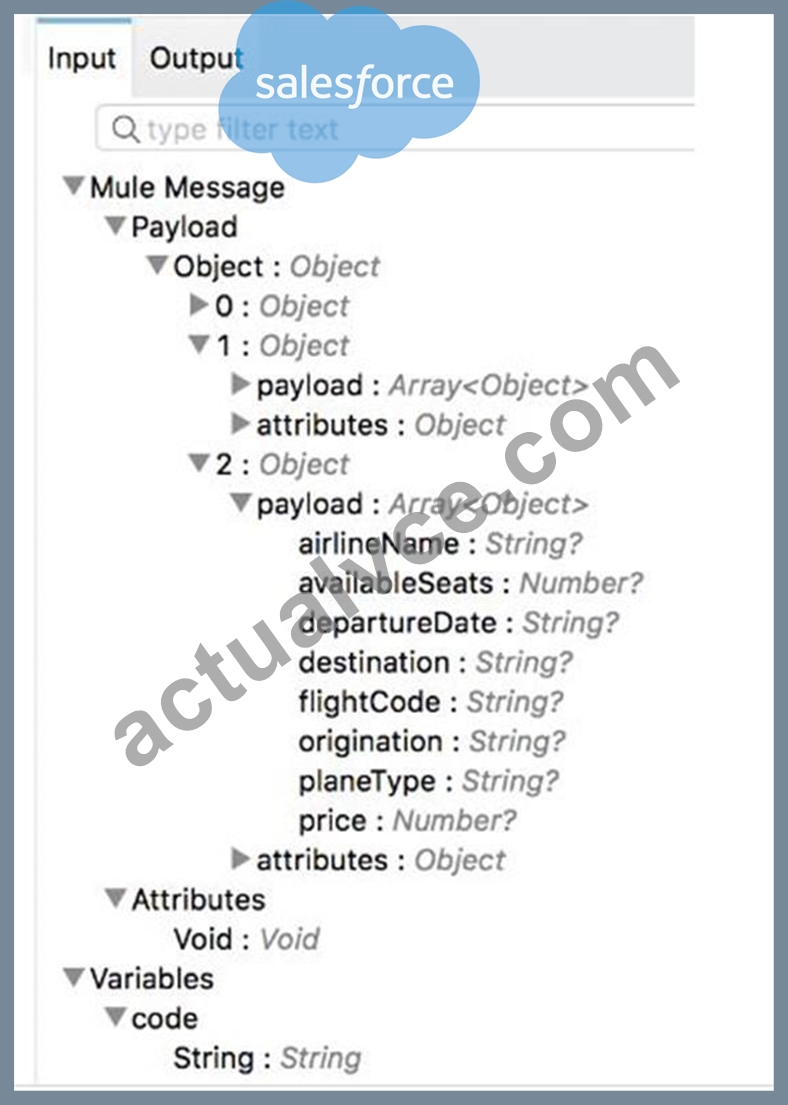
MuleSoft Documentation reference :https://docs.mulesoft.com/mule-runtime/4.3/scatter-gather-concept
NEW QUESTION # 145
Refer to the exhibit. The main flow contains an HTTP Request in the middle of the flow. The HTTP Listeners and HTTP request use default configurations.
What
values are accessible to the Logger at the end of the flow after a web client submit request tohttp://local:801
/order?color=red?
- A. payload quantity var
- B. payload
- C. payload quantity var color query param
- D. payload color query param
Answer: A
Explanation:
In this case as outbound call is made using HTTP: POST /child , all attributes will be replacedby this invocation. Hence query parameter will not be accessible at logger.
NEW QUESTION # 146
What statement is a part of MuleSoft's description of an application network?
- A. Creates and manages a collection of JMS messaging services and infrastructure
- B. Creates reusable APIs and assets designed to be consumed by other business units
- C. Creates and manages high availability and fault tolerant services and infrastructure
- D. Leverages Central IT to deliver complete point-to-point solutions with master data management
Answer: B
Explanation:
Creates reusable APIs and assets designed to be consumed by other business units
NEW QUESTION # 147
Refer to the exhibit.
What datais expected by the POST /accounts endpoint?
- A.

- B.

- C.

- D.

Answer: A
NEW QUESTION # 148
Refer to the exhibits.
The
Mule application implements a RESTAPI that accepts GET requests from web clients on the URLs:
http://acme com/order/status and http:Vacme.com/customer/status.
What path value can be set in the HTTP GE~ event source to accept web client requests from both of these URLs?
- A. *[order,customer]/status
- B. */status
- C. ?[order,customer]/status
- D. *status
Answer: B
NEW QUESTION # 149
Refer to the exhibits.
How many private flows does APIKIt generate from RAML specification?
- A. 0
- B. 1
- C. 2
- D. 3
Answer: B
Explanation:
APIKIt Creates a separate flow for each HTTP method. Hence 4 private flows would be generated.
MuleSoft Documentation Referrence :https://docs.mulesoft.com/mule-runtime/4.3/build-application-from-api
NEW QUESTION # 150
Which of the below functionality is provided by zip operator in DataWeave?
- A. All of the above
- B. Used for sending attachments
- C. Merges elements of two lists (arrays) into a single list
- D. Minimize the size of long text using encoding.
Answer: C
Explanation:
Correct answer is Merges elements of two lists (arrays) into a single list MuleSoft Doc Reference : https://docs.mulesoft.com/mule-runtime/4.3/dw-core-functions-zip
NEW QUESTION # 151
Refer to the exhibit.
What DataWeave expression transforms the conductorlds arrayto the XML output?
- A.

- B.

- C.

- D.

Answer: D
NEW QUESTION # 152
What path setting is required for an HTTP Listener endpoint to route all requests to an APIkit router?
- A. /
- B. "/*"
- C. /()
- D. /(*)
Answer: B
Explanation:
Option1 is correct syntax to configure HTTP Listener endpoint
NEW QUESTION # 153
Refer to the exhibits. The main flow contains an HTTP Request operation configured to call the child flow's HTTP Listener.
A web client sends a GET request to the HTTP Listener with the sty query parameter set to 30.
After the HTTP Request operation completes, what parts of the Mule event at the main flow's Logger component are the same as the Mule event that was input to the HTTP Request operation?
- A. All variables
- B. The payload and all attributes
- C. The entire Mule event
- D. The payload and all variables
Answer: D
NEW QUESTION # 154
Refer to the exhibits.

A web client sends a POST request to the HTTP Listener with the payload "Hello-". What response is returned to the web client?
What response is returned to the web client?
- A. Helb-JMS1-HTTP-JMS2 -Three
- B. Hello- HTTP-] MS2-Three
- C. HTTP-JMS2-Three
- D. Hello-HTTP-Three
Answer: B
NEW QUESTION # 155
Refer to the exhibits.
Each route in the Scatter-Gather sets the payload to the number shown in the label. What response is returned to a web client request to the HTTP Listener?
- A.

- B.

- C.

- D.

Answer: B
Explanation:
Correct answer is as below.
After all processing routes have finished execution, the Scatter-Gather component creates a new Mule event that combines all resulting Mule events from each route, and then passes the new Mule event to the next component in the flow.
{
"0": {
"attributes": ...,
"payload": "100"
},
"1": {
"attributes": ...,
"payload": "200"
}
}
Bottom of Form
NEW QUESTION # 156
Refer to the exhibits.
The mule application is debugged in Anypoint Studio and stops at the breakpoint as shown in below exhibit.
What is the value of the payload displayed in the debugger at this breakpoint?
- A. Process
- B. Finished
- C. Payload is always empty at the breakpoint
- D. Start
Answer: D
Explanation:
Setting Breakpoints
To set breakpoints, right-click a building block, then select Toggle Breakpoint.
Studio applies a red dot to the building block's icon on the canvas.
When you run your application in Debug mode, Studio stops the flow execution at the breakpoint you have set, allowing you to check the Mule Event content in the Mule Debugger View.
Mule Ref Doc : Setting Breakpoints | MuleSoft Documentation
NEW QUESTION # 157
Refer to the exhibits. What payload is logged at the end of the main flow?
- A. [1, 2, 3, 4]
- B. [order1, order2, order3, order4]
- C. order1order2order3order4
- D. order4
Answer: A
Explanation:
For Each Scope
The For Each scope splits a payload into elements and processes them one by one through the components that you place in the scope. It is similar to a for-each/for loop code block in most programminglanguages and can process any collection, including lists and arrays. The collection can be any supported content type, such as application/json, application/java, or application/xml.
General considerations about the For Each scope:
By default, For Each tries to split the payload. If the payload is a simple Java collection, the For Each scope can split it without any configuration. The payload inside the For Each scope is each of the split elements.
Attributes within the original message are ignored becausethey are related to the entire message.
For Each does not modify the current payload. The output payload is the same as the input.
Mule Doc Reference : https://docs.mulesoft.com/mule-runtime/4.3/for-each-scope-concept
NEW QUESTION # 158
......
Salesforce Salesforce-MuleSoft-Developer-I Exam Syllabus Topics:
| Topic | Details |
|---|---|
| Topic 1 |
|
| Topic 2 |
|
| Topic 3 |
|
| Topic 4 |
|
| Topic 5 |
|
| Topic 6 |
|
| Topic 7 |
|
| Topic 8 |
|
| Topic 9 |
|
Updated PDF (New 2026) Actual Salesforce Salesforce-MuleSoft-Developer-I Exam Questions: https://www.actualvce.com/Salesforce/Salesforce-MuleSoft-Developer-I-valid-vce-dumps.html
Verified Salesforce-MuleSoft-Developer-I Exam Dumps PDF [2026] Access using ActualVCE: https://drive.google.com/open?id=1fNuwBNHiyaNUsq89teK9OVgF1abdlP-T