

Dumps Moneyack Guarantee - 3V0-42.20 Dumps UpTo 50% Off
Updated Jan-2022 Pass 3V0-42.20 Exam - Real Practice Test Questions
Understanding functional and technical aspects of Advanced Design VMware NSX-T Data Center 3.0 Installing, Configuring, and Setup
The following will be discussed in VMWARE 3V0-42.20 dumps:
- Understand and apply a design framework
- Design a data center rack solution to support scalability and high availability
- Explain the Federation functionality
- Design a physical network to support network virtualization in a software-defined data center
- Logical Switching Design
- Describe the traffic flooding concepts
- Review Federation design considerations
- List the NSX-T Management cluster design considerations
- NSX-T Data Center Design Considerations
- Describe VMware Tanzu⢠Kubernetes Grid⢠Service
- Describe the NSX-T Data Center architecture and use cases
- Explain the VMware NSX-T⢠logical switching design concepts
- Understand the integration between NSX-T Data Center and vSphere with VMware Tanzuâ¢
- Analyze alternative design choices for risk mitigation
- Explain physical infrastructure design considerations
- Explain virtual infrastructure design considerations
- Design a VMware vSphereî virtual data center to support NSX-T Data Center requirements
- Describe the design involved for Federation networking
- Explain the NSX-T Data Center and Virtual Cloud Network
Exam Topics for Advanced Design VMware NSX-T Data Center 3.0
The following will be discussed in VMWARE 3V0-42.20 exam dumps:
- Architecture and Technologies â Products and Solutions â Planning and Designing â Installing, Configuring, and Setup â Performance-tuning, Optimization, and Upgrades â Troubleshooting and Repairing â Administrative and Operational Tasks
NEW QUESTION 28
An architect is helping an organization with the Logical Design of an NSX-T Data Center solution.
This information was gathered during the assessment:
There must be a performance based SLA for East - West traffic.
Which two key performance features should the architect recommend? (Choose two.)
- A. Leverage DPDK drivers
- B. Configure N-VDS enhanced Data Path
- C. Enable GENEVE Offload
- D. Install advanced Edge pNIC Features
- E. Setup RSS to leverage multiple cores
Answer: C,E
NEW QUESTION 29
An architect is helping an organization with the Logical Design of an NSX-T Data Center solution.
This information was gathered during the Assessment Phase:
Customer is concerned with NSX Manager availability.
3 cabinets/racks are available in the data center.
No integration with 3rd party solution is required.
There is no budget for physical equipment acquisition.
The 3 cabinets/racks do not share the same L2 domain.
Which three selections should the architect include in their design to address the customer's concern with NSX Manager availability? (Choose three.)
- A. Deploy 2 cold standby NSX Manager appliances in rack 2/3.
- B. Use another NSX Manager IP in case an appliance fails.
- C. Use separate IP per NSX Manager appliance per rack.
- D. Use a physical/internal load-balancer with the cluster.
- E. Deploy an NSX Manager Appliance per rack and cluster them.
- F. Deploy a single active NSX Manager appliance in rack 1.
Answer: A,E,F
NEW QUESTION 30
An architect is helping an organization with the Physical Design of an NSX-T Data Center solution.
This information was gathered during a workshop about ESXi Host networking:
* A total of 50 ESXi hosts to be configured as Transport Nodes.
* All ESXi hosts have a dedicated 2 × Intel 10Gbps Physical Network adapter for the Overlay Traffic.
To achieve low latency, high throughput, redundancy, and performance, which two NIC teaming policies should the architect recommend? (Choose two.)
- A. Load Balance Source MAC
- B. Failover Order
- C. Load Balance Port ID
- D. Load Balance Source
- E. Load Balance Source Port ID
Answer: B,E
NEW QUESTION 31
Refer to the exhibit.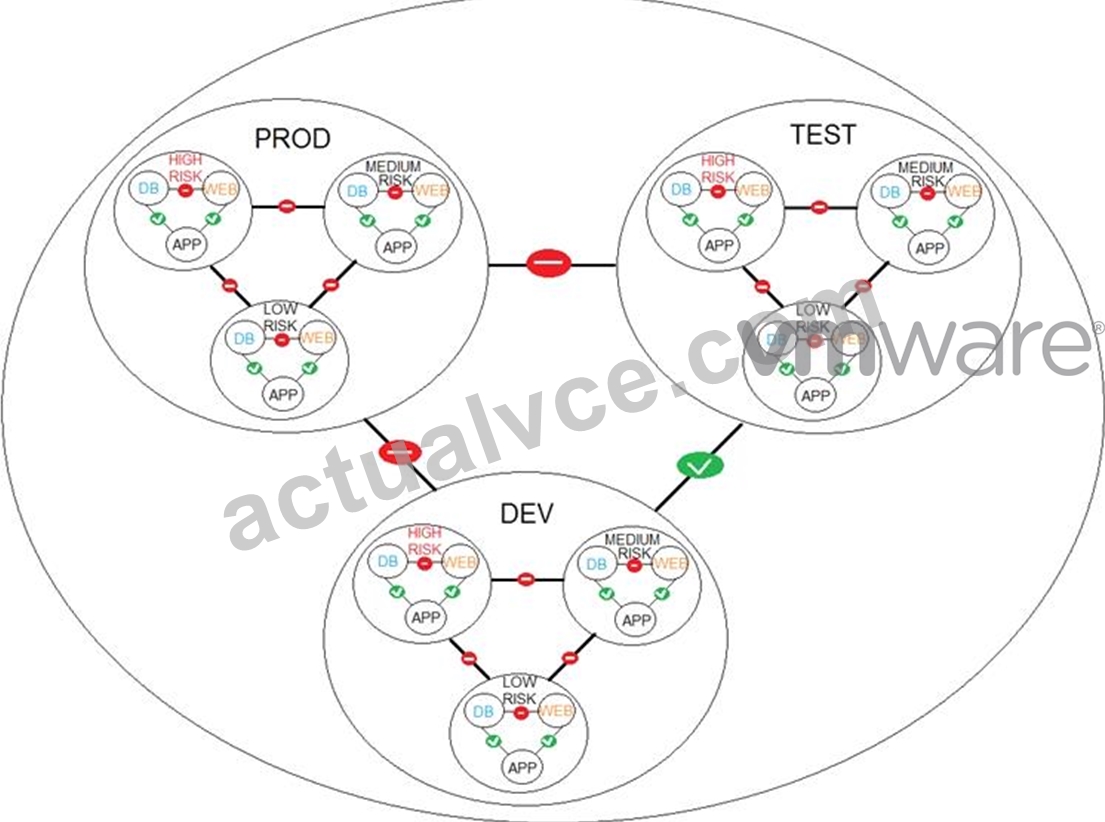
A financial company is adopting micro-services with the intent of simplifying network security. An NSX-T architect is proposing a NSX-T Data Center micro-segmentation logical design. The architect has created a diagram to share with the customer.
How many security levels will be implemented according to this Logical Design? (Choose the best answer.)
- A. 5 levels
- B. 9 levels
- C. 4 levels
- D. 3 levels
Answer: A
NEW QUESTION 32
An architect is helping an organization with the Logical Design of a Layer 2 bridging solution.
This information was gathered during the Assessment Phase:
Workloads are running on ESXi hosts.
Workloads are running on KVM hosts.
Workloads on hypervisors should use bridging services.
VLAN 50 is used for Tier-0 uplink connectivity.
Which selection should the architect include in their design? (Choose the best answer.)
- A. Create an NSX Edge Bridge Cluster and configure the bridging profile with VLAN 60.
- B. Create an ESXi Bridge Cluster and configure the bridging profile with VLAN 50.
- C. Create an ESXi Bridge Cluster and configure the bridging profile with VLAN 60.
- D. Create an NSX Edge Bridge Cluster and configure the bridging profile with VLAN 50.
Answer: D
NEW QUESTION 33
An architect is helping an organization with the Conceptual Design of an NSX-T Data Center solution.
Which three selections are requirements documented by an architect? (Choose three.)
- A. SAN storage has enough capacity to build the new infrastructure.
- B. Aggregate N-S throughput at any given time should be at least 10G.
- C. All traffic should recover in the event of Host/Rack/ToR failure.
- D. Business critical applications should have an SLA of 99.99%.
- E. The Development Team are heavy on API usage.
- F. Hardware is 5 years old and new hardware is already purchased.
Answer: B,E,F
NEW QUESTION 34
Which three choices are part of a Design Approach when discussing design alternatives and their effects?
(Choose three.)
- A. backup
- B. performance
- C. cost
- D. budget
- E. knowledge
- F. security
Answer: B,E,F
NEW QUESTION 35
Refer to the exhibit.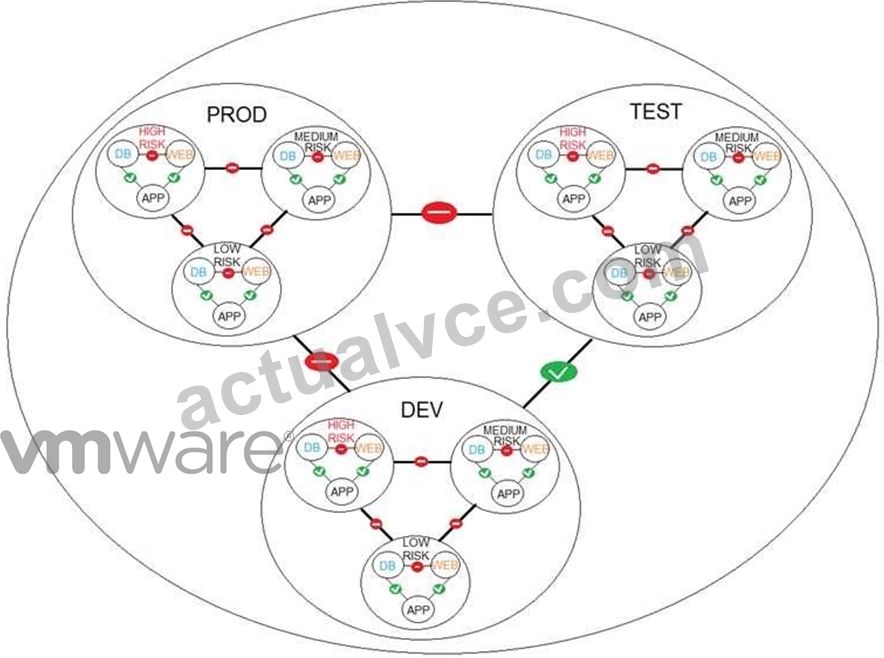
A financial company is adopting micro-services with the intent of simplifying network security. An NSX-T architect is proposing a NSX-T Data Center micro-segmentation logical design. The architect has created a diagram to share with the customer.
How many security levels will be implemented according to this Logical Design? (Choose the best answer.)
- A. 5 levels
- B. 9 levels
- C. 4 levels
- D. 3 levels
Answer: A
NEW QUESTION 36
Which selection must be taken into consideration when creating a Logical Design for a planned migration? (Choose the best answer.)
- A. An N-VDS can only attach to a single VLAN transport zone.
- B. An N-VDS must be disabled before attaching both Overlay and VLAN transport zones.
- C. An N-VDS can attach to both an Overlay and a VLAN transport zone to a N-VDS having different name/s.
- D. An N-VDS can only attach to a single Overlay transport zone.
Answer: A
NEW QUESTION 37
Which two benefits can be achieved using in-band management of an NSX Bare Metal Edge Node? (Choose two.)
- A. Reduces cost.
- B. Preserves switchports.
- C. Preserves packet locality.
- D. Reduces egress data.
- E. Reduces storage requirements.
Answer: A,D
NEW QUESTION 38
A Solutions Architect is assisting a service provider with designing an NSX-T Data Center solution for these environments:
Virtual Data Center to Virtual Data Center connectivity
Tenant workload on-boarding to Virtual Data Centers.
These requirements must be met:
scalability across 5 data centers
all sites have a latency of 180ms
MTU between sites is 1800
bandwidth is 100Mbps between sites
multi-tenancy
Which two selections should the Solutions Architect propose to the service provider? (Choose two.)
- A. Configure IPSec VPN for Tenant T0 gateways for Virtual Data Centers connectivity
- B. Configure Remote TEPs for stretching network services between Virtual Data Centers.
- C. Utilize SSL VPN for workloads on-boarding from on-premises to Virtual Data Centers.
- D. Utilize L2 VPN for workloads on-boarding from on-premises to Virtual Data Centers.
- E. Configure IPSec VPN for Tenant T1 gateways for Virtual Data Centers connectivity.
Answer: D,E
NEW QUESTION 39
Which three choices are part of a Design Approach when discussing design alternatives and their effects? (Choose three.)
- A. backup
- B. performance
- C. cost
- D. budget
- E. knowledge
- F. security
Answer: B,E,F
NEW QUESTION 40
Refer to the exhibits.
Design Option1: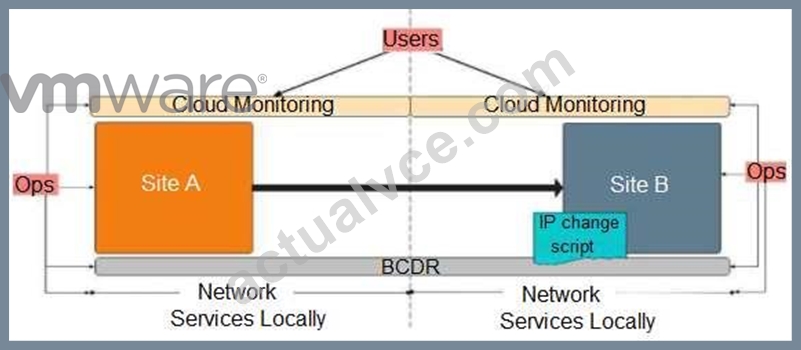
Design Option 2: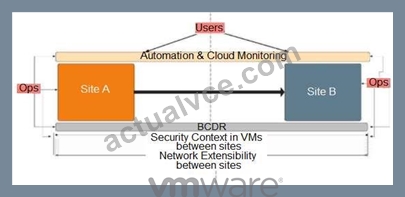
Design Option 3: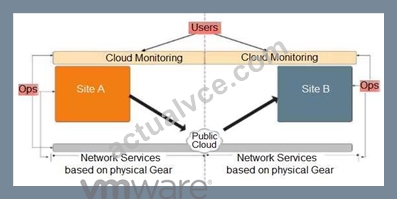
Design Option 4: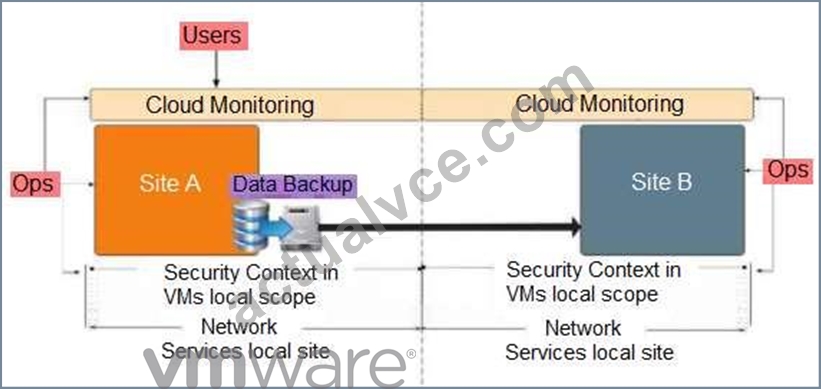
An architect is helping an organization with the Conceptual Design of an NSX-T Data Center solution.
The conceptual design includes these requirements, assumptions, constraints, and risks:
* Critical applications must run across sites without changing IP address.
* Business continuity and disaster recovery (BCDR) plans will leverage a second site running vSphere.
* RTO/RPO must be reduced for recovery of applications on secondary site.
* IT Teams require automation tools for configuration.
Which Conceptual Design would the architect recommend to the customer? (Choose the best answer.)
- A. Design Option 4
- B. Design Option 2
- C. Design Option 1
- D. Design Option 3
Answer: C
NEW QUESTION 41
Which selection is associated with the Review Task of the Engagement Lifecycle? (Choose the best answer.)
- A. Measure performance against customer's objective.
- B. Create and document the logical and physical design.
- C. Build, deploy, implement, and test the design.
- D. Gather and document requirements, assumptions, and constraints.
Answer: A
NEW QUESTION 42
A customer wants to place their NSX Managers in different subnets.
Which would an architect recommend to support the request? (Choose the best answer.)
- A. Use round-robin DNS.
- B. Use NAT.
- C. Use a load balancer.
- D. Use a cluster Virtual IP.
Answer: D
Explanation:
Explanation/Reference: http://www.cloudxtreme.info/nsx-t-manager-clustering/
NEW QUESTION 43
An architect is helping an organization with the Physical Design of an NSX-T Data Center solution.
This information was gathered during the Assessment Phase:
There is a critical application used by the Finance Team.
The critical application has an availability and recoverability SLA of 99.999%.
The critical application is sensitive to network changes.
Which two selections should an architect include in their design? (Choose two.)
- A. Configure Tier-1 gateway for eBGP and ECMP.
- B. Configure Tier-0 gateway for eBGP and ECMP.
- C. Enable BFD on Tier-0 gateway.
- D. Install and configure hosts with 100Gbps physical NICs.
- E. Configure multiple static routes on Tier-1 gateway.
Answer: A,D
NEW QUESTION 44
A telecom company has purchased NSX-T as part of a Software Defined Data Center (SDDC) initiative. The company wants to ensure the highest performance for network traffic leaving the virtual environment.
Which two selections would an architect recommend to achieve the customer's goal? (Choose two.)
- A. Configure Equal-Cost Multi-Pathing on the NSX Edges.
- B. Use bare metal NSX Edges.
- C. Select Network cards that support VXLAN Offload.
- D. Configure SR-IOV for the virtual NSX Edges.
- E. Set "Latency Sensitive" option to High when deploying the virtual NSX Edges.
Answer: D,E
NEW QUESTION 45
An architect is helping an organization with the Physical Design of an NSX-T Data Center solution.
This information was gathered during a workshop:
* Any proposed solution must provide low latency.
* Any proposed solution must provide high throughput.
* Customer is running stock trading applications.
Which two selections should the architect recommend to meet high-performance workload requirements?
(Choose two.)
- A. Leverage ESXi as the compute host.
- B. Enable latency sensitivity mode on the N-VDS.
- C. Leverage KVM as the compute host.
- D. Enable enhanced data path mode on the N-VDS.
- E. Use LACP for all uplink profiles.
Answer: A,D
NEW QUESTION 46
An architect is helping an organization with the Physical Design of an NSX-T Data Center solution.
This information was gathered during a workshop:
Some workloads should be moved to a Cloud Provider.
Extend network's VLAN or VNI across sites on the same broadcast domain.
Enable VM mobility use cases such as migration and disaster recovery without IP address changes.
Support 1500 byte MTU between sites.
Which selection should the architect include in their design? (Choose the best answer.)
- A. Reflexive NAT
- B. L2 VPN
- C. SSL VPN
- D. Load Balancer
Answer: B
NEW QUESTION 47
A customer has a requirement to implement a next generation firewall (NGFW) to improve security network introspection. The customer wants to apply the NGFW to all workloads exposed both internally and externally. The customer wants the NGFW to work seamlessly with NSX-T Data Center and vSphere.
Which solution should be recommended to the customer? (Choose the best answer.)
- A. Apply the NGFW to internal and external workloads for increased protection and use NSX-T Data Center with Federation to set network policies.
- B. Use NSX-T Data Center leveraged with NSX Intelligence to protect all workloads at the network inspection level.
- C. Use network introspection only on the external workloads and use NSX DFW for internal workloads.
- D. Apply the NGFW on bare metal hosts which will offer better performance of inline network introspection.
Answer: B
NEW QUESTION 48
Which two resources can be used by an NSX architect during the Assessment Phase? (Choose two.)
- A. application licensing
- B. VMware Validated Design
- C. VMware customer references
- D. vRealize Network Insight
- E. key stakeholder interviews
Answer: A,D
NEW QUESTION 49
An architect is helping an organization with the Logical Design of an NSX-T Data Center solution.
This information was gathered during the Assessment Phase:
There is a performance based SLA for East - West traffic.
The business critical applications require prioritization of their traffic.
One of the services is a file share and has a high demand for bandwidth.
Which selection should the architect include in their design? (Choose the best answer.)
- A. Monitor East-West traffic throughout normal business cycles.
- B. Include a segment QoS profile and review the impact of utilizing this feature.
- C. Review average North/South traffic from the core switches and firewall.
- D. Meet with the organization's application team to get additional information.
Answer: B
NEW QUESTION 50
An administrator is asked to improve Recovery Point Objective (RPO) and Recovery Time Objective (RTO) for Disaster Recovery (DR) in their company network. The network has a primary site and a secondary site. The ability to support outages with minimum loss of connectivity to the company's core application is a priority.
Which design should the administrator recommend? (Choose the best answer.)
- A. NSX-T Data Center using a registered third-party DR solution.
- B. NSX-T Data Center using built-in standard automation DR and secondary site recovery setup.
- C. NSX-T Data Center using Federation and dependencies set between primary and secondary sites.
- D. NSX-T Data Center using an Orchestrator to recover VMs across sites.
Answer: C
NEW QUESTION 51
A Solution Architect will be deploying an Ethernet Virtual Private Network (EVPN) in their NSX-T Data Center environment.
What two selections must be prepared for the EVPN deployment? (Choose two.)
- A. remote gateway with support for IGP and VLAN priority
- B. deployed Tier-1 gateway
- C. remote gateway with support for MP-BGP and VXLAN
- D. deployed Load Balancer
- E. deployed Tier-0 gateway
Answer: C,D
Explanation:
Explanation/Reference: https://docs.vmware.com/en/VMware-NSX-T-Data-Center/3.0/nsxt_30_admin.pdf
NEW QUESTION 52
An architect is helping an organization with the Logical Design of an NSX-T Data Center solution.
This information was gathered during the Assessment Phase:
NSX-T will span across two sites for disaster recovery.
Public Load Balancer VIP should be accessible from a secondary site.
Distributed Firewall Policies should be available at a secondary site.
Routing capabilities should be maintained after failure.
NAT capabilities are required.
Which two selections should the architect include in their design? (Choose two.)
- A. Set MTU to 1550 between sites.
- B. Use two separate ISPs across sites.
- C. Use MTU to 1550 between sites.
- D. Use IP sets or groups to configure DFW rules.
- E. Use of the same ISPs across sites.
Answer: D,E
Explanation:
Reference:
site-solutions-cross-vcenter-nsx-design-guide.pdf
NEW QUESTION 53
......
Download Free VMware 3V0-42.20 Real Exam Questions: https://www.actualvce.com/VMware/3V0-42.20-valid-vce-dumps.html