

COF-C02 Premium Files Updated Apr-2025 Practice Valid Exam Dumps Question
Practice with COF-C02 Dumps for SnowPro Core Certified Exam Questions & Answer
NEW QUESTION # 190
What should be considered when deciding to use a secure view? (Select TWO).
- A. Secure views do not take advantage of the same internal optimizations as standard views.
- B. No details of the query execution plan will be available in the query profiler.
- C. Once created there is no way to determine if a view is secure or not.
- D. It is not possible to create secure materialized views.
- E. The view definition of a secure view is still visible to users by way of the information schema.
Answer: A,B
Explanation:
When deciding to use a secure view, several considerations come into play, especially concerning security and performance:
A;No details of the query execution plan will be available in the query profiler: Secure views are designed to prevent the exposure of the underlying data and the view definition to unauthorized users. Because of this, the detailed execution plans for queries against secure views are not available in the query profiler. This is intended to protect sensitive data from being inferred through the execution plan.
C:Secure views do not take advantage of the same internal optimizations as standard views: Secure views, by their nature, limit some of the optimizations that can be applied compared to standard views. This is because they enforce row-level security and mask data, which can introduce additional processing overhead and limit the optimizer's ability to apply certain efficiencies that are available to standard views.
B:Once created, there is no way to determine if a view is secure or notis incorrect because metadata about whether a view is secure can be retrieved from the INFORMATION_SCHEMA views or by using theSHOW VIEWScommand.
D:It is not possible to create secure materialized viewsis incorrect because the limitation is not on the security of the view but on the fact that Snowflake currently does not support materialized views with the same dynamic data masking and row-level security features as secure views.
E:The view definition of a secure view is still visible to users by way of the information schemais incorrect because secure views specifically hide the view definition from users who do not have the privilege to view it, ensuring that sensitive information in the definition is not exposed.
Reference: Snowflake Documentation on Secure Views
(https://docs.snowflake.com/en/user-guide/views-secure.html)
NEW QUESTION # 191
Which file function provides a URL with access to a file on a stage without the need for authentication and authorization?
- A. BUILD_STAGE_FILE_URL
- B. GET_PRESIGNED_URL
- C. BUILD_SCOPED_FILE_URL
- D. GET_RELATIVE_PATH
Answer: B
Explanation:
The GET_PRESIGNED_URL file function in Snowflake provides a URL with access to a file on a stage without requiring authentication and authorization. This is particularly useful for sharing data files stored in Snowflake stages with external parties securely and conveniently. The presigned URL generated by this function gives temporary access to the file, which expires after a specified duration.
Example usage of GET_PRESIGNED_URL:
SELECT GET_PRESIGNED_URL('<stage_name>', '<file_path>');
This function generates a URL that can be used to directly access a file in the stage, making it easier to share data without compromising security.
Reference:
Top of Form
NEW QUESTION # 192
Which chart type is supported in Snowsight for Snowflake users to visualize data with dashboards?
- A. Box plot
- B. Area chart
- C. Pie chart
- D. Heat grid
Answer: B
Explanation:
Snowsight, Snowflake's user interface for exploring, analyzing, and visualizing data, supports a variety of chart types for creating dashboards and visualizations. One of the supported chart types in Snowsight is the Area Chart (A). Area charts are useful for representing quantities over time and can be used to highlight volume change and rate of change, as well as to compare multiple quantities.
While Snowsight supports many types of visualizations to help users analyze their data effectively, including line charts, bar charts, and scatter plots, it's important to select the specific reference documentation or release notes for the most current list of supported chart types, as Snowflake continues to enhance and update Snowsight's capabilities.
As of the last update, Box plots (B), Heat grids (C), and Pie charts (D) are types of visualizations that may be supported in various analytics and visualization tools, but for the specific context of Snowsight's currently confirmed features, Area charts are a verified option for users to visualize their data.
Reference: Snowflake Documentation on Snowsight
(https://docs.snowflake.com/en/user-guide/ui-snowsight.html)
NEW QUESTION # 193
By definition, a secure view is exposed only to users with what privilege?
- A. USAGE
- B. REFERENCES
- C. OWNERSHIP
- D. IMPORT SHARE
Answer: C
Explanation:
A secure view in Snowflake is exposed only to users with the OWNERSHIP privilege. This privilege ensures that only authorized users who own the view, or roles that include ownership, can access the secure view
NEW QUESTION # 194
When loading data into Snowflake, how should the data be organized?
- A. Into single files with 1-100 MB of compressed data per file
- B. Into files of maximum size of 4 GB of compressed data per file
- C. Into files of maximum size of 1 GB of compressed data per file
- D. Into single files with 100-250 MB of compressed data per file
Answer: D
Explanation:
When loading data into Snowflake, it is recommended to organize the data into single files with 100-250 MB of compressed data per file. This size range is optimal for parallel processing and can help in achieving better performance during data loading operations. References: [COF-C02] SnowPro Core Certification Exam Study Guide
NEW QUESTION # 195
Which parameter can be used to instruct a COPY command to verify data files instead of loading them into a specified table?
- A. STRIP_NULL_VALUES
- B. VALIDATION_MODE
- C. SKIP_BYTE_ORDER_MARK
- D. REPLACE_INVALID_CHARACTERS
Answer: B
Explanation:
Explanation
https://docs.snowflake.com/en/sql-reference/sql/copy-into-table.html
VALIDATION_MODE = RETURN_n_ROWS | RETURN_ERRORS | RETURN_ALL_ERRORS
String (constant) that instructs the COPY command to validate the data files instead of loading them into the specified table; i.e. the COPY command tests the files for errors but does not load them. The command validates the data to be loaded and returns results based on the validation option specified:
NEW QUESTION # 196
What Snowflake feature provides a data hub for secure data collaboration, with a selected group of invited members?
- A. Snowflake Marketplace
- B. Data Replication
- C. Secure Data Sharing
- D. Data Exchange
Answer: D
Explanation:
Snowflake's Data Exchange feature provides a data hub for secure data collaboration. It allows providers to publish data that can be discovered and accessed by a selected group of invited members, facilitating secure and controlled data sharing within a collaborative environment3. Reference: [COF-C02] SnowPro Core Certification Exam Study Guide
NEW QUESTION # 197
Regardless of which notation is used, what are considerations for writing the column name and element names when traversing semi-structured data?
- A. The column name is case-insensitive but element names are case-sensitive.
- B. The column name and element names are both case-insensitive.
- C. The column name is case-sensitive but element names are case-insensitive.
- D. The column name and element names are both case-sensitive.
Answer: A
NEW QUESTION # 198
How can an administrator check for updates (for example, SCIM API requests) sent to Snowflake by the identity provider?
- A. QUERY_HISTORY
- B. ACCESS_HISTORY
- C. LOAD_HISTORY
- D. REST EVENT HISTORY
Answer: D
Explanation:
To monitor updates, such as SCIM API requests sent to Snowflake by the identity provider, an administrator can use the REST EVENT HISTORY feature. This feature allows administrators to query historical data about REST API calls made to Snowflake, including those related to user and role management through SCIM (System for Cross-domain Identity Management).
The REST EVENT HISTORY table function returns information about REST API calls made over a specified period. It is particularly useful for auditing and monitoring purposes, especially when integrating Snowflake with third-party identity providers that use SCIM for automated user provisioning and deprovisioning.
An example query to check for SCIM API requests might look like this:
SELECT * FROM
TABLE(information_schema.rest_event_history(date_range_start=>dateadd('hours',-1,current_timestamp()))) WHERE request_type = 'SCIM'; This query returns details on SCIM API requests made in the last hour, including the request type, the identity provider's details, and the outcome of each request.
Reference: Snowflake Documentation on REST EVENT HISTORY
(https://docs.snowflake.com/en/sql-reference/functions/rest_event_history.html)
NEW QUESTION # 199
What impacts the credit consumption of maintaining a materialized view? (Choose two.)
- A. How often the materialized view is queried
- B. Whether the materialized view has a cluster key defined
- C. How often the underlying base table is queried
- D. How often the base table changes
- E. Whether or not it is also a secure view
Answer: A,B
NEW QUESTION # 200
What is used to denote a pre-computed data set derived from a SELECT query specification and stored for later use?
- A. Materialized view
- B. View
- C. External table
- D. Secure view
Answer: A
Explanation:
A materialized view in Snowflake denotes a pre-computed data set derived from a SELECT query specification and stored for later use. Unlike standard views, which dynamically compute the data each time the view is accessed, materialized views store the result of the query at the time it is executed, thereby speeding up access to the data, especially for expensive aggregations on large datasets.
References:
* Snowflake Documentation: Materialized Views
NEW QUESTION # 201
What is an advantage of using an explain plan instead of the query profiler to evaluate the performance of a query?
- A. An explain plan can be used to conduct performance analysis without executing a query.
- B. An explain plan will handle queries with temporary tables and the query profiler will not.
- C. The explain plan output is available graphically.
- D. An explain plan's output will display automatic data skew optimization information.
Answer: A
Explanation:
An explain plan is beneficial because it allows for the evaluation of how a query will be processed without the need to actually execute the query. This can help in understanding the query's performance implications and potential bottlenecks without consuming resources that would be used if the query were run
NEW QUESTION # 202
A JSON document is stored in the source_colum of type VARIANT. The document has an array called elements. The array contains the name key that has a string value How can a Snowflake user extract the name from the first element?
- A. Source_column.element[1]:name
- B. Source_column.element[1].name
- C. Source_column.element[0]:name
- D. Source_column.element[0]:name
Answer: B
Explanation:
In Snowflake, when dealing with semi-structured data such as a JSON document stored in a VARIANT column, the proper syntax to extract a value is to use the column name followed by the path to the specific element. Since arrays in JSON are zero-indexed, the first element is referenced with [0]. Therefore, to extract the name from the first element of the elements array, the correct syntax is Source_column:elements[0].name.References: Snowflake Documentation on Semi-Structured Data
NEW QUESTION # 203
A JSON document is stored in the source_colum of type VARIANT. The document has an array called elements. The array contains the name key that has a string value How can a Snowflake user extract the name from the first element?
- A. Source_column.element[1]:name
- B. Source_column.element[1].name
- C. Source_column.element[0]:name
- D. Source_column.element[0]:name
Answer: B
Explanation:
In Snowflake, when dealing with semi-structured data such as a JSON document stored in a VARIANT column, the proper syntax to extract a value is to use the column name followed by the path to the specific element. Since arrays in JSON are zero-indexed, the first element is referenced with [0]. Therefore, to extract the name from the first element of the elements array, the correct syntax is Source_column:elements[0].name.
Reference: Snowflake Documentation on Semi-Structured Data
NEW QUESTION # 204
What is the minimum Snowflake edition needed for database failover and fail-back between Snowflake accounts for business continuity and disaster recovery?
- A. Standard
- B. Business Critical
- C. Virtual Private Snowflake
- D. Enterprise
Answer: B
Explanation:
The minimum Snowflake edition required for database failover and fail-back between Snowflake accounts for business continuity and disaster recovery is the Business Critical edition. References: Snowflake Documentation3.
NEW QUESTION # 205
A tabular User-Defined Function (UDF) is defined by specifying a return clause that contains which keyword?
- A. VALUES
- B. TABLE
- C. ROW_NUMBER
- D. TABULAR
Answer: B
Explanation:
In Snowflake, a tabular User-Defined Function (UDF) is defined with a return clause that includes the keyword "TABLE." This indicates that the UDF will return a set of rows, which can be used in the FROM clause of a query. Reference: Based on my internal knowledge as of 2021.
NEW QUESTION # 206
If 3 size Small virtual warehouse is made up of two servers, how many servers make up a Large warehouse?
- A. 0
- B. 1
- C. 2
- D. 3
Answer: D
Explanation:
Size specifies the amount of compute resources available per cluster in a warehouse. Snowflake supports the following warehouse sizes: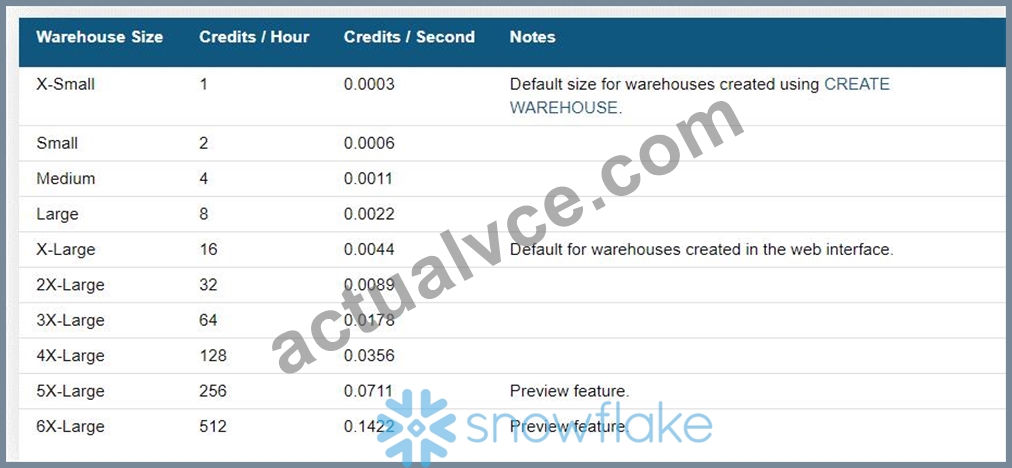
https://docs.snowflake.com/en/user-guide/warehouses-overview.html
NEW QUESTION # 207
User1, who has the SYSADMIN role, executed a query on Snowsight. User2, who is in the same Snowflake account, wants to view the result set of the query executed by User1 using the Snowsight query history.
What will happen if User2 tries to access the query history?
- A. If User2 has the ACCOUNTADMIN role they will be able to see the results.
- B. User2 will be unable to view the result set of the query executed by User1.
- C. If User2 has the securityadmin role they will be able to see the results.
- D. If User2 has the sysadmin role they will be able to see the results.
Answer: A
Explanation:
In Snowflake, the query history and the results of queries executed by a user are accessible based on the roles and permissions. If User1 executed a query with the SYSADMIN role, User2 would be able to view the result set of that query executed by User1 only if User2 has the ACCOUNTADMIN role. The ACCOUNTADMIN role has the broadest set of privileges, including the ability to access all aspects of the account's operation, data, and query history, thus enabling User2 to view the results of queries executed by other users.
Reference:
Snowflake Documentation: Understanding Snowflake Roles
NEW QUESTION # 208
How many network policies can be assigned to an account or specific user at a time?
- A. Unlimited
- B. One
- C. Two
- D. Three
Answer: B
Explanation:
According to my knowledge, a security administrator can create multiple network policies, but only one network policy can be active for an account or specific user at any given time. This ensures that there is a clear and consistent policy being applied without conflicts. Reference: Based on my internal knowledge as of 2021.
NEW QUESTION # 209
A user needs to MINIMIZE the cost of large tables that are used to store transitory data. The data does not need to be protected against failures, because the data can be reconstructed outside of Snowflake.
What table type should be used?
- A. Permanent
- B. Externa
- C. Temporary
- D. Transient
Answer: D
Explanation:
For minimizing the cost of large tables that are used to store transitory data, which does not need to be protected against failures because it can be reconstructed outside of Snowflake, the best table type to use is Transient. Transient tables in Snowflake are designed for temporary or transitory data storage and offer reduced storage costs compared to permanent tables. However, unlike temporary tables, they persist across sessions until explicitly dropped.
* Why Transient Tables:Transient tables provide a cost-effective solution for storing data that is temporary but needs to be available longer than a single session. They have lower data storage costs because Snowflake does not maintain historical data (Time Travel) for as long as it does for permanent tables.
* Creating a Transient Table:
* To create a transient table, use theTRANSIENTkeyword in the CREATE TABLE statement:
CREATETRANSIENTTABLEmy_transient_table (...);
* Use Case Considerations:Transient tables are ideal for scenarios where the data is not critical, can be easily recreated, and where cost optimization is a priority. They are suitable for development, testing, or staging environments where data longevity is not a concern.
Reference:For more details on transient tables and their usage scenarios, refer to the Snowflake documentation on table types: https://docs.snowflake.com/en/sql-reference/sql/create-table.html#table-types
NEW QUESTION # 210
Which Snowflake SQL statement would be used to determine which users and roles have access to a role called MY_ROLE?
- A. SHOW GRANTS TO ROLE MY_ROLE
- B. SHOW GRANTS FOR ROLE MY_ROLE
- C. SHOW GRANTS ON ROLE MY_ROLE
- D. SHOW GRANTS OF ROLE MY_ROLE
Answer: A
Explanation:
The SQL statement SHOW GRANTS TO ROLE MY_ROLE is used to determine which users and roles have access to a role called MY_ROLE. This statement lists all the privileges granted to the role, including which roles and users can assume MY_ROLE. Reference: [COF-C02] SnowPro Core Certification Exam Study Guide
NEW QUESTION # 211
Which data type can be used to store geospatial data in Snowflake?
- A. Object
- B. Variant
- C. Geometry
- D. Geography
Answer: D
Explanation:
Snowflake supports two geospatial data types: GEOGRAPHY and GEOMETRY. The GEOGRAPHY data type is used to store geospatial data that models the Earth as a perfect sphere, which is suitable for global geospatial data. This data type follows the WGS 84 standard and is used for storing points, lines, and polygons on the Earth's surface. The GEOMETRY data type, on the other hand, represents features in a planar (Euclidean, Cartesian) coordinate system and is typically used for local spatial reference systems. Since the question specifically asks about geospatial data, which commonly refers to Earth-related spatial data, the correct answer is GEOGRAPHY3. Reference: [COF-C02] SnowPro Core Certification Exam Study Guide
NEW QUESTION # 212
Which activities are included in the Cloud Services layer? {Select TWO).
- A. Partition scanning
- B. User authentication
- C. Data storage
- D. Dynamic data masking
- E. Infrastructure management
Answer: B,E
NEW QUESTION # 213
......
REAL COF-C02 Exam Questions With 100% Refund Guarantee : https://www.actualvce.com/Snowflake/COF-C02-valid-vce-dumps.html
Get Special Discount Offer on COF-C02 Dumps PDF: https://drive.google.com/open?id=1BuamBq92hVfQVU9xcoCK9zH8zmZzRQWl