

Pass Google Professional-Machine-Learning-Engineer Exam With Practice Test Questions Dumps Bundle
2024 Valid Professional-Machine-Learning-Engineer test answers & Google Exam PDF
Google Professional Machine Learning Engineer Certification Exam is an opportunity for individuals to validate their expertise in the field of machine learning. Google Professional Machine Learning Engineer certification exam is designed to test the individual's knowledge of machine learning concepts and their ability to apply these concepts in real-world scenarios. It is a rigorous exam that requires individuals to demonstrate their ability to design, build, and deploy scalable machine learning models using Google Cloud Platform.
To be eligible for the Google Professional Machine Learning Engineer certification exam, candidates must have a minimum of three years of experience in the field of machine learning. Candidates should also have experience in designing and implementing machine learning solutions using Google Cloud technologies such as Google Cloud ML Engine, BigQuery, and TensorFlow. In addition to these requirements, candidates should have a strong understanding of machine learning algorithms and data structures.
NEW QUESTION # 71
Your team needs to build a model that predicts whether images contain a driver's license, passport, or credit card. The data engineering team already built the pipeline and generated a dataset composed of 10,000 images with driver's licenses, 1,000 images with passports, and 1,000 images with credit cards. You now have to train a model with the following label map: ['driversjicense', 'passport', 'credit_card']. Which loss function should you use?
- A. Categorical hinge
- B. Binary cross-entropy
- C. Categorical cross-entropy
- D. Sparse categorical cross-entropy
Answer: C
Explanation:
- **Categorical entropy** is better to use when you want to **prevent the model from giving more importance to a certain class**. Or if the **classes are very unbalanced** you will get a better result by using Categorical entropy.
- But **Sparse Categorical Entropy** is a more optimal coice if you have a huge amount of classes, enough to make a lot of memory usage, so since sparse categorical entropy uses less columns it **uses less memory**.
https://stats.stackexchange.com/questions/326065/cross-entropy-vs-sparse-cross-entropy-when-to-use-one-over-the-other
NEW QUESTION # 72
You are an ML engineer at a manufacturing company You are creating a classification model for a predictive maintenance use case You need to predict whether a crucial machine will fail in the next three days so that the repair crew has enough time to fix the machine before it breaks. Regular maintenance of the machine is relatively inexpensive, but a failure would be very costly You have trained several binary classifiers to predict whether the machine will fail. where a prediction of 1 means that the ML model predicts a failure.
You are now evaluating each model on an evaluation dataset. You want to choose a model that prioritizes detection while ensuring that more than 50% of the maintenance jobs triggered by your model address an imminent machine failure. Which model should you choose?
- A. The model with the highest recall where precision is greater than 0.5.
- B. The model with the highest precision where recall is greater than 0.5.
- C. The model with the lowest root mean squared error (RMSE) and recall greater than 0.5.
- D. The model with the highest area under the receiver operating characteristic curve (AUC ROC) and precision greater than 0 5
Answer: A
Explanation:
In predictive maintenance, the goal is to identify which machines are likely to fail soon, so that the repair crew can fix them before they break. In this context, it is important to prioritize detection, while also ensuring that more than 50% of the maintenance jobs triggered by your model address an imminent machine failure.
Recall is a metric that measures the proportion of actual positive observations that are correctly predicted as such by the model. In this case, recall is a good metric to use because it measures how well the model is able to identify the machines that are likely to fail soon.
Precision is a metric that measures the proportion of positive predictions that are actually true. In this case, precision is also important because it measures how many of the machines that the model predicts will fail soon, actually do fail soon.
By combining these two metrics, you can ensure that your model is able to identify the machines that are likely to fail soon with a high degree of accuracy. In this case, the model with the highest recall where precision is greater than 0.5 will be the best model, as it will have a high ability to identify the machines that are likely to fail soon and also it will have a high degree of accuracy.
Reference:
Recall and Precision
Predictive Maintenance
Metrics for classification
NEW QUESTION # 73
You are an ML engineer on an agricultural research team working on a crop disease detection tool to detect leaf rust spots in images of crops to determine the presence of a disease. These spots, which can vary in shape and size, are correlated to the severity of the disease. You want to develop a solution that predicts the presence and severity of the disease with high accuracy. What should you do?
- A. Create an object detection model that can localize the rust spots.
- B. Develop an image segmentation ML model to locate the boundaries of the rust spots.
- C. Develop a template matching algorithm using traditional computer vision libraries.
- D. Develop an image classification ML model to predict the presence of the disease.
Answer: B
NEW QUESTION # 74
You work on a data science team at a bank and are creating an ML model to predict loan default risk. You have collected and cleaned hundreds of millions of records worth of training data in a BigQuery table, and you now want to develop and compare multiple models on this data using TensorFlow and Vertex AI. You want to minimize any bottlenecks during the data ingestion state while considering scalability. What should you do?
- A. Use the BigQuery client library to load data into a dataframe, and use tf.data.Dataset.from_tensor_slices() to read it.
- B. Convert the data into TFRecords, and use tf.data.TFRecordDataset() to read them.
- C. Export data to CSV files in Cloud Storage, and use tf.data.TextLineDataset() to read them.
- D. Use TensorFlow I/O's BigQuery Reader to directly read the data.
Answer: C
NEW QUESTION # 75
You are creating a model training pipeline to predict sentiment scores from text-based product reviews. You want to have control over how the model parameters are tuned, and you will deploy the model to an endpoint after it has been trained You will use Vertex Al Pipelines to run the pipeline You need to decide which Google Cloud pipeline components to use What components should you choose?
- A.

- B.

- C.

- D.

Answer: D
NEW QUESTION # 76
A city wants to monitor its air quality to address the consequences of air pollution. A Machine Learning Specialist needs to forecast the air quality in parts per million of contaminates for the next 2 days in the city. As this is a prototype, only daily data from the last year is available.
Which model is MOST likely to provide the best results in Amazon SageMaker?
- A. Use the Amazon SageMaker Linear Learner algorithm on the single time series consisting of the full year of data with a predictor_typeof regressor.
- B. Use Amazon SageMaker Random Cut Forest (RCF) on the single time series consisting of the full year of data.
- C. Use the Amazon SageMaker Linear Learner algorithm on the single time series consisting of the full year of data with a predictor_typeof classifier.
- D. Use the Amazon SageMaker k-Nearest-Neighbors (kNN) algorithm on the single time series consisting of the full year of data with a predictor_typeof regressor.
Answer: A
Explanation:
Explanation/Reference: https://aws.amazon.com/blogs/machine-learning/build-a-model-to-predict-the-impact-of-weather- on-urban-air-quality-using-amazon-sagemaker/?ref=Welcome.AI
NEW QUESTION # 77
You are developing a recommendation engine for an online clothing store. The historical customer transaction data is stored in BigQuery and Cloud Storage. You need to perform exploratory data analysis (EDA), preprocessing and model training. You plan to rerun these EDA, preprocessing, and training steps as you experiment with different types of algorithms. You want to minimize the cost and development effort of running these steps as you experiment. How should you configure the environment?
- A. Create a Vertex Al Workbench managed notebook to browse and query the tables directly from the JupyterLab interface.
- B. Create a Vertex Al Workbench user-managed notebook using the default VM instance, and use the %%bigquery magic commands in Jupyter to query the tables.
- C. Create a Vertex Al Workbench user-managed notebook on a Dataproc Hub. and use the %%bigquery magic commands in Jupyter to query the tables.
- D. Create a Vertex Al Workbench managed notebook on a Dataproc cluster, and use the spark-bigquery-connector to access the tables.
Answer: A
NEW QUESTION # 78
You work for a company that captures live video footage of checkout areas in their retail stores You need to use the live video footage to build a mode! to detect the number of customers waiting for service in near real time You want to implement a solution quickly and with minimal effort How should you build the model?
- A. Use the Vertex Al Vision Person/vehicle detector model
- B. Use the Vertex Al Vision Occupancy Analytics model.
- C. Train a Seq2Seq+ object detection model on an annotated dataset by using Vertex AutoML
- D. Train an AutoML object detection model on an annotated dataset by using Vertex AutoML
Answer: B
NEW QUESTION # 79
A company wants to classify user behavior as either fraudulent or normal. Based on internal research, a Machine Learning Specialist would like to build a binary classifier based on two features: age of account and transaction month. The class distribution for these features is illustrated in the figure provided.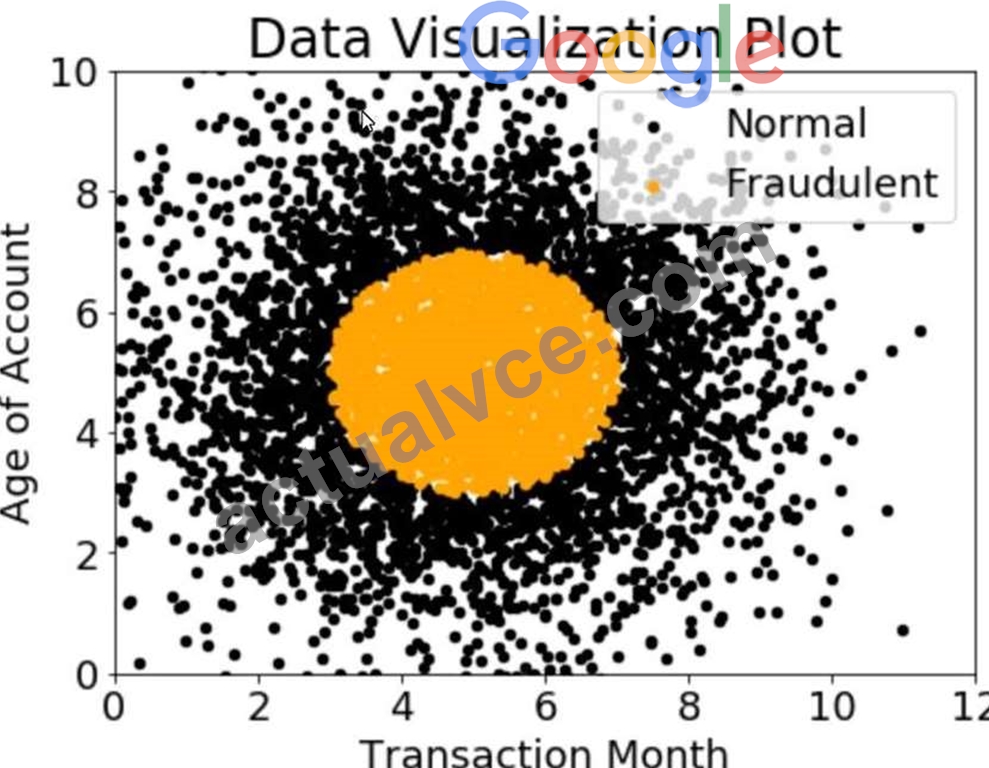
Based on this information, which model would have the HIGHEST accuracy?
- A. Support vector machine (SVM) with non-linear kernel
- B. Long short-term memory (LSTM) model with scaled exponential linear unit (SELU)
- C. Single perceptron with tanh activation function
- D. Logistic regression
Answer: A
NEW QUESTION # 80
Your team is working on an NLP research project to predict political affiliation of authors based on articles they have written. You have a large training dataset that is structured like this: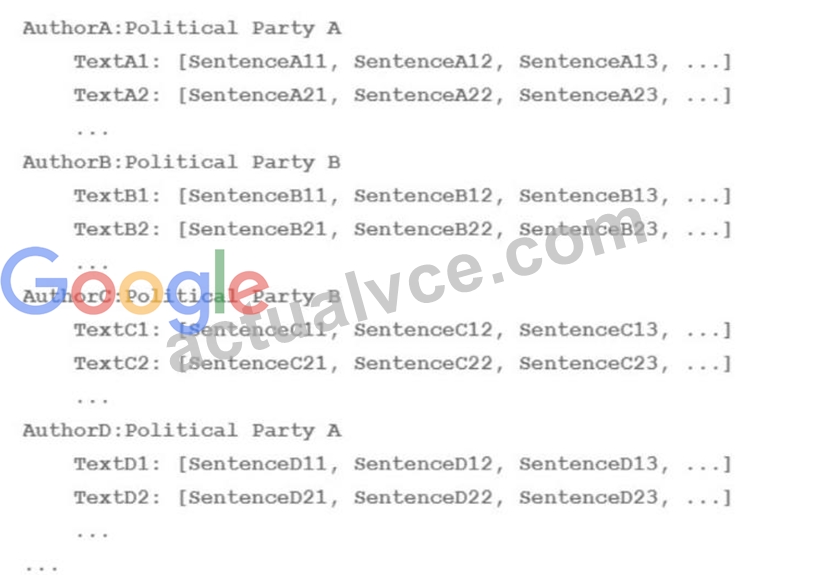
A)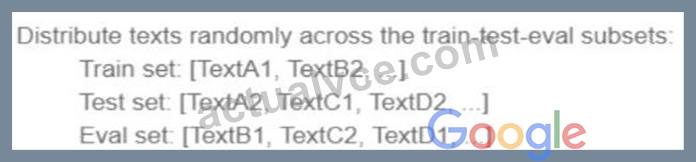
B)
C)
D)
- A. Option C
- B. Option A
- C. Option B
- D. Option D
Answer: C
Explanation:
If we just put inside the Training set , Validation set and Test set , randomly Text, Paragraph or sentences the model will have the ability to learn specific qualities about The Author's use of language beyond just his own articles. Therefore the model will mixed up different opinions. Rather if we divided things up a the author level, so that given authors were only on the training data, or only in the test data or only in the validation data. The model will find more difficult to get a high accuracy on the test validation (What is correct and have more sense!). Because it will need to really focus in author by author articles rather than get a single political affiliation based on a bunch of mixed articles from different authors. https://developers.google.com/machine-learning/crash-course/18th-century-literature For example, suppose you are training a model with purchase data from a number of stores. You know, however, that the model will be used primarily to make predictions for stores that are not in the training data. To ensure that the model can generalize to unseen stores, you should segregate your data sets by stores. In other words, your test set should include only stores different from the evaluation set, and the evaluation set should include only stores different from the training set. https://cloud.google.com/automl-tables/docs/prepare#ml-use
NEW QUESTION # 81
A Machine Learning Specialist works for a credit card processing company and needs to predict which transactions may be fraudulent in near-real time. Specifically, the Specialist must train a model that returns the probability that a given transaction may fraudulent.
How should the Specialist frame this business problem?
- A. Binary classification
- B. Streaming classification
- C. Regression classification
- D. Multi-category classification
Answer: D
NEW QUESTION # 82
You have recently created a proof-of-concept (POC) deep learning model. You are satisfied with the overall architecture, but you need to determine the value for a couple of hyperparameters. You want to perform hyperparameter tuning on Vertex AI to determine both the appropriate embedding dimension for a categorical feature used by your model and the optimal learning rate. You configure the following settings:
For the embedding dimension, you set the type to INTEGER with a minValue of 16 and maxValue of 64.
For the learning rate, you set the type to DOUBLE with a minValue of 10e-05 and maxValue of 10e-02.
You are using the default Bayesian optimization tuning algorithm, and you want to maximize model accuracy. Training time is not a concern. How should you set the hyperparameter scaling for each hyperparameter and the maxParallelTrials?
- A. Use UNIT_LOG_SCALE for the embedding dimension, UNIT_LINEAR_SCALE for the learning rate, and a large number of parallel trials.
- B. Use UNIT_LOG_SCALE for the embedding dimension, UNIT_LINEAR_SCALE for the learning rate, and a small number of parallel trials.
- C. Use UNIT_LINEAR_SCALE for the embedding dimension, UNIT_LOG_SCALE for the learning rate, and a small number of parallel trials.
- D. Use UNIT_LINEAR_SCALE for the embedding dimension, UNIT_LOG_SCALE for the learning rate, and a large number of parallel trials.
Answer: C
NEW QUESTION # 83
You built and manage a production system that is responsible for predicting sales numbers. Model accuracy is crucial, because the production model is required to keep up with market changes. Since being deployed to production, the model hasn't changed; however the accuracy of the model has steadily deteriorated. What issue is most likely causing the steady decline in model accuracy?
- A. Poor data quality
- B. Lack of model retraining
- C. Too few layers in the model for capturing information
- D. Incorrect data split ratio during model training, evaluation, validation, and test
Answer: D
NEW QUESTION # 84
During batch training of a neural network, you notice that there is an oscillation in the loss. How should you adjust your model to ensure that it converges?
- A. Increase the learning rate hyperparameter
- B. Decrease the size of the training batch
- C. Increase the size of the training batch
- D. Decrease the learning rate hyperparameter
Answer: A
Explanation:
https://developers.google.com/machine-learning/crash-course/introduction-to-neural-networks/playground-exercises
NEW QUESTION # 85
Your team has been tasked with creating an ML solution in Google Cloud to classify support requests for one of your platforms. You analyzed the requirements and decided to use TensorFlow to build the classifier so that you have full control of the model's code, serving, and deployment. You will use Kubeflow pipelines for the ML platform. To save time, you want to build on existing resources and use managed services instead of building a completely new model. How should you build the classifier?
- A. Use AutoML Natural Language to build the support requests classifier
- B. Use an established text classification model on Al Platform to perform transfer learning
- C. Use the Natural Language API to classify support requests
- D. Use an established text classification model on Al Platform as-is to classify support requests
Answer: D
NEW QUESTION # 86
You work at a leading healthcare firm developing state-of-the-art algorithms for various use cases You have unstructured textual data with custom labels You need to extract and classify various medical phrases with these labels What should you do?
- A. Use the Healthcare Natural Language API to extract medical entities.
- B. Use TensorFlow to build a custom medical entity extraction model.
- C. Use a BERT-based model to fine-tune a medical entity extraction model.
- D. Use AutoML Entity Extraction to train a medical entity extraction model.
Answer: C
NEW QUESTION # 87
You work for a gaming company that manages a popular online multiplayer game where teams with 6 players play against each other in 5-minute battles. There are many new players every day. You need to build a model that automatically assigns available players to teams in real time. User research indicates that the game is more enjoyable when battles have players with similar skill levels. Which business metrics should you track to measure your model's performance?
- A. User engagement as measured by the number of battles played daily per user
- B. Rate of return as measured by additional revenue generated minus the cost of developing a new model
- C. Precision and recall of assigning players to teams based on their predicted versus actual ability
- D. Average time players wait before being assigned to a team
Answer: A
NEW QUESTION # 88
You are an ML engineer at a global shoe store. You manage the ML models for the company's website. You are asked to build a model that will recommend new products to the user based on their purchase behavior and similarity with other users. What should you do?
- A. Build a knowledge-based filtering model
- B. Build a classification model
- C. Build a regression model using the features as predictors
- D. Build a collaborative-based filtering model
Answer: D
NEW QUESTION # 89
You need to develop an image classification model by using a large dataset that contains labeled images in a Cloud Storage Bucket. What should you do?
- A. Import the labeled images as a managed dataset in Vertex Al: and use AutoML to tram the model.
- B. Convert the image dataset to a tabular format using Dataflow Load the data into BigQuery and use BigQuery ML to tram the model.
- C. Use Vertex Al Pipelines with TensorFlow Extended (TFX) to create a pipeline that reads the images from Cloud Storage and trams the model.
- D. Use Vertex Al Pipelines with the Kubeflow Pipelines SDK to create a pipeline that reads the images from Cloud Storage and trains the model.
Answer: D
NEW QUESTION # 90
......
Top Google Professional-Machine-Learning-Engineer Courses Online: https://www.actualvce.com/Google/Professional-Machine-Learning-Engineer-valid-vce-dumps.html
Free Google Professional-Machine-Learning-Engineer Exam Questions and Answer from Training Expert ActualVCE: https://drive.google.com/open?id=1WLNG8eHDE3X6wfcJbmGw8H1V87jag97b