

Tested Material Used To Professional-Machine-Learning-Engineer Test Engine Exam Questions in here [Sep-2021]
Penetration testers simulate Professional-Machine-Learning-Engineer exam PDF
NEW QUESTION 35
You have a functioning end-to-end ML pipeline that involves tuning the hyperparameters of your ML model using Al Platform, and then using the best-tuned parameters for training. Hypertuning is taking longer than expected and is delaying the downstream processes. You want to speed up the tuning job without significantly compromising its effectiveness. Which actions should you take?
Choose 2 answers
- A. Decrease the range of floating-point values
- B. Change the search algorithm from Bayesian search to random search.
- C. Decrease the number of parallel trials
- D. Set the early stopping parameter to TRUE
- E. Decrease the maximum number of trials during subsequent training phases.
Answer: A,B
NEW QUESTION 36
You need to train a computer vision model that predicts the type of government ID present in a given image using a GPU-powered virtual machine on Compute Engine. You use the following parameters:
* Optimizer: SGD
* Image shape = 224x224
* Batch size = 64
* Epochs = 10
* Verbose = 2
During training you encounter the following error: ResourceExhaustedError: out of Memory (oom) when allocating tensor. What should you do?
- A. Reduce the image shape
- B. Change the learning rate
- C. Reduce the batch size
- D. Change the optimizer
Answer: C
NEW QUESTION 37
You work for a large technology company that wants to modernize their contact center. You have been asked to develop a solution to classify incoming calls by product so that requests can be more quickly routed to the correct support team. You have already transcribed the calls using the Speech-to-Text API. You want to minimize data preprocessing and development time. How should you build the model?
- A. Use the Cloud Natural Language API to extract custom entities for classification
- B. Build a custom model to identify the product keywords from the transcribed calls, and then run the keywords through a classification algorithm
- C. Use the Al Platform Training built-in algorithms to create a custom model
- D. Use AutoML Natural Language to extract custom entities for classification
Answer: C
NEW QUESTION 38
You are an ML engineer in the contact center of a large enterprise. You need to build a sentiment analysis tool that predicts customer sentiment from recorded phone conversations. You need to identify the best approach to building a model while ensuring that the gender, age, and cultural differences of the customers who called the contact center do not impact any stage of the model development pipeline and results. What should you do?
- A. Convert the speech to text and build a model based on the words
- B. Extract sentiment directly from the voice recordings
- C. Convert the speech to text and extract sentiments based on the sentences
- D. Convert the speech to text and extract sentiment using syntactical analysis
Answer: C
NEW QUESTION 39
You are an ML engineer at a global car manufacturer. You need to build an ML model to predict car sales in different cities around the world. Which features or feature crosses should you use to train city-specific relationships between car type and number of sales?
- A. One feature obtained as an element-wise product between binned latitude, binned longitude, and one-hot encoded car type
- B. Three individual features binned latitude, binned longitude, and one-hot encoded car type
- C. One feature obtained as an element-wise product between latitude, longitude, and car type
- D. Two feature crosses as a element-wise product the first between binned latitude and one-hot encoded car type, and the second between binned longitude and one-hot encoded car type
Answer: B
NEW QUESTION 40
A Machine Learning Specialist wants to bring a custom algorithm to Amazon SageMaker. The Specialist implements the algorithm in a Docker container supported by Amazon SageMaker.
How should the Specialist package the Docker container so that Amazon SageMaker can launch the training correctly?
- A. Configure the training program as an ENTRYPOINTnamed train
- B. Use CMD configin the Dockerfile to add the training program as a CMD of the image
- C. Modify the bash_profile file in the container and add a bashcommand to start the training program
- D. Copy the training program to directory /opt/ml/train
Answer: B
NEW QUESTION 41
You are an ML engineer at a bank that has a mobile application. Management has asked you to build an ML-based biometric authentication for the app that verifies a customer's identity based on their fingerprint. Fingerprints are considered highly sensitive personal information and cannot be downloaded and stored into the bank databases. Which learning strategy should you recommend to train and deploy this ML model?
- A. Differential privacy
- B. Federated learning
- C. MD5 to encrypt data
- D. Data Loss Prevention API
Answer: B
NEW QUESTION 42
Your team trained and tested a DNN regression model with good results. Six months after deployment, the model is performing poorly due to a change in the distribution of the input dat a. How should you address the input differences in production?
- A. Perform feature selection on the model, and retrain the model on a monthly basis with fewer features
- B. Create alerts to monitor for skew, and retrain the model.
- C. Perform feature selection on the model, and retrain the model with fewer features
- D. Retrain the model, and select an L2 regularization parameter with a hyperparameter tuning service
Answer: D
NEW QUESTION 43
You need to build classification workflows over several structured datasets currently stored in BigQuery. Because you will be performing the classification several times, you want to complete the following steps without writing code: exploratory data analysis, feature selection, model building, training, and hyperparameter tuning and serving. What should you do?
- A. Use Al Platform to run the classification model job configured for hyperparameter tuning
- B. Configure AutoML Tables to perform the classification task
- C. Run a BigQuery ML task to perform logistic regression for the classification
- D. Use Al Platform Notebooks to run the classification model with pandas library
Answer: C
Explanation:
BigQuery ML supports supervised learning with the logistic regression model type.
NEW QUESTION 44
You work with a data engineering team that has developed a pipeline to clean your dataset and save it in a Cloud Storage bucket. You have created an ML model and want to use the data to refresh your model as soon as new data is available. As part of your CI/CD workflow, you want to automatically run a Kubeflow Pipelines training job on Google Kubernetes Engine (GKE). How should you architect this workflow?
- A. Use Cloud Scheduler to schedule jobs at a regular interval. For the first step of the job. check the timestamp of objects in your Cloud Storage bucket If there are no new files since the last run, abort the job.
- B. Configure a Cloud Storage trigger to send a message to a Pub/Sub topic when a new file is available in a storage bucket. Use a Pub/Sub-triggered Cloud Function to start the training job on a GKE cluster
- C. Configure your pipeline with Dataflow, which saves the files in Cloud Storage After the file is saved, start the training job on a GKE cluster
- D. Use App Engine to create a lightweight python client that continuously polls Cloud Storage for new files As soon as a file arrives, initiate the training job
Answer: B
NEW QUESTION 45
You are training an LSTM-based model on Al Platform to summarize text using the following job submission script: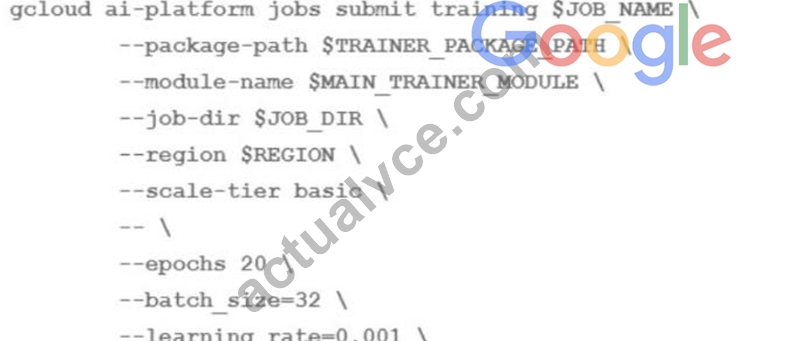
You want to ensure that training time is minimized without significantly compromising the accuracy of your model. What should you do?
- A. Modify the 'scale-tier' parameter
- B. Modify the 'learning rate' parameter
- C. Modify the 'epochs' parameter
- D. Modify the batch size' parameter
Answer: D
NEW QUESTION 46
Your team is working on an NLP research project to predict political affiliation of authors based on articles they have written. You have a large training dataset that is structured like this: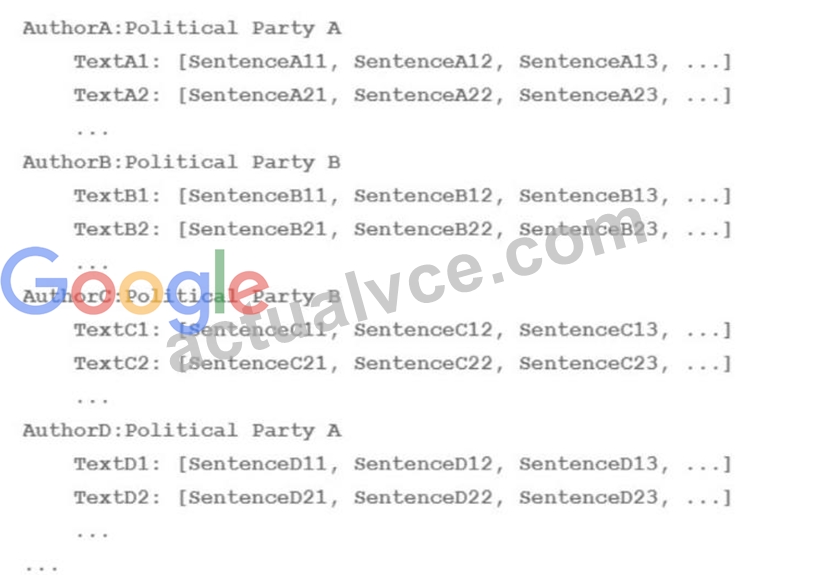
A)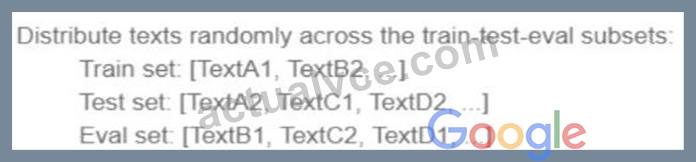
B)
C)
D)
- A. Option D
- B. Option C
- C. Option A
- D. Option B
Answer: B
NEW QUESTION 47
You have trained a text classification model in TensorFlow using Al Platform. You want to use the trained model for batch predictions on text data stored in BigQuery while minimizing computational overhead. What should you do?
- A. Use Dataflow with the SavedModel to read the data from BigQuery
- B. Deploy and version the model on Al Platform.
- C. Submit a batch prediction job on Al Platform that points to the model location in Cloud Storage.
- D. Export the model to BigQuery ML.
Answer: D
NEW QUESTION 48
You recently joined a machine learning team that will soon release a new project. As a lead on the project, you are asked to determine the production readiness of the ML components. The team has already tested features and data, model development, and infrastructure. Which additional readiness check should you recommend to the team?
- A. Ensure that training is reproducible
- B. Ensure that model performance is monitored
- C. Ensure that all hyperparameters are tuned
- D. Ensure that feature expectations are captured in the schema
Answer: A
NEW QUESTION 49
A Machine Learning Specialist is building a model that will perform time series forecasting using Amazon SageMaker. The Specialist has finished training the model and is now planning to perform load testing on the endpoint so they can configure Auto Scaling for the model variant.
Which approach will allow the Specialist to review the latency, memory utilization, and CPU utilization during the load test?
- A. Generate an Amazon CloudWatch dashboard to create a single view for the latency, memory utilization, and CPU utilization metrics that are outputted by Amazon SageMaker.
- B. Build custom Amazon CloudWatch Logs and then leverage Amazon ES and Kibana to query and visualize the log data as it is generated by Amazon SageMaker.
- C. Send Amazon CloudWatch Logs that were generated by Amazon SageMaker to Amazon ES and use Kibana to query and visualize the log data.
- D. Review SageMaker logs that have been written to Amazon S3 by leveraging Amazon Athena and Amazon QuickSight to visualize logs as they are being produced.
Answer: A
Explanation:
Explanation/Reference: https://docs.aws.amazon.com/sagemaker/latest/dg/monitoring-cloudwatch.html
NEW QUESTION 50
During batch training of a neural network, you notice that there is an oscillation in the loss. How should you adjust your model to ensure that it converges?
- A. Decrease the learning rate hyperparameter
- B. Increase the learning rate hyperparameter
- C. Decrease the size of the training batch
- D. Increase the size of the training batch
Answer: B
NEW QUESTION 51
You are an ML engineer at a regulated insurance company. You are asked to develop an insurance approval model that accepts or rejects insurance applications from potential customers. What factors should you consider before building the model?
- A. Redaction, reproducibility, and explainability
- B. Federated learning, reproducibility, and explainability
- C. Differential privacy federated learning, and explainability
- D. Traceability, reproducibility, and explainability
Answer: A
NEW QUESTION 52
......
Authentic Best resources for Professional-Machine-Learning-Engineer Online Practice Exam: https://www.actualvce.com/Google/Professional-Machine-Learning-Engineer-valid-vce-dumps.html
Get the superior quality Professional-Machine-Learning-Engineer Dumps with explanations waiting just for you, get it now: https://drive.google.com/open?id=1VRJ5MstPJYbHhCLhIUsK5mIUHdXdHHkK