

Get 100% Passing Success With True MS-500 Exam! [Sep-2021]
Microsoft MS-500 PDF Questions - Exceptional Practice To Microsoft 365 Security Administration
NEW QUESTION 124
You have a Microsoft Azure Active Directory (Azure AD) tenant named contoso.com that contains the users shown in the following table.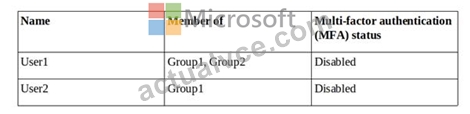
You create and enforce an Azure AD Identity Protection sign-in risk policy that has the following settings:
* Assignments: Include Group1, Exclude Group2
* Conditions: Sign in risk of Low and above
* Access: Allow access, Require password multi-factor authentication
You need to identify how the policy affects User1 and User2.
What occurs when each user signs in from an anonymous IP address? To answer, select the appropriate options in the answer area.
NOTE: Each correct selection is worth one point.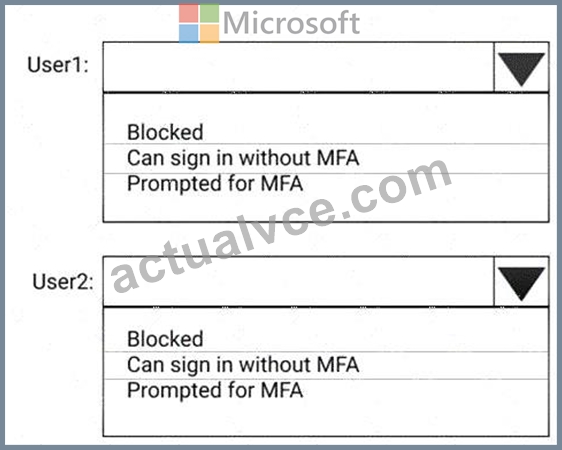
Answer:
Explanation: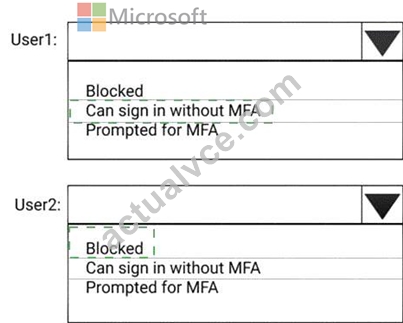
Explanation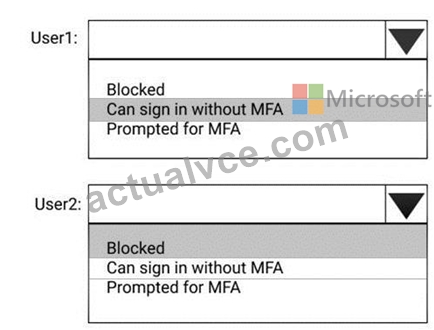
NEW QUESTION 125
Please wait while the virtual machine loads. Once loaded, you may proceed to the lab section. This may take a few minutes, and the wait time will not be deducted from your overall test time.
When the Next button is available, click it to access the lab section. In this section, you will perform a set of tasks in a live environment. While most functionality will be available to you as it would be in a live environment, some functionality (e.g., copy and paste, ability to navigate to external websites) will not be possible by design.
Scoring is based on the outcome of performing the tasks stated in the lab. In other words, it doesn't matter how you accomplish the task, if you successfully perform it, you will earn credit for that task.
Labs are not timed separately, and this exam may more than one lab that you must complete. You can use as much time as you would like to complete each lab. But, you should manage your time appropriately to ensure that you are able to complete the lab(s) and all other sections of the exam in the time provided.
Please note that once you submit your work by clicking the Next button within a lab, you will NOT be able to return to the lab.
Username and password
Use the following login credentials as needed:
To enter your username, place your cursor in the Sign in box and click on the username below.
To enter your password, place your cursor in the Enter password box and click on the password below.
Microsoft 365 Username:
admin@[email protected]
Microsoft 365 Password: #HSP.ug?$p6un
If the Microsoft 365 portal does not load successfully in the browser, press CTRL-K to reload the portal in a new browser tab.
The following information is for technical support only:
Lab instance: 11122308
You need to create an Azure Information Protection label to meet the following requirements:
* Content must expire after 21 days.
* Offline access must be allowed for 21 days only.
* Documents must be protected by using a cloud key.
* Authenticated users must be able to view content only.
To complete this task, sign in to the Microsoft 365 admin center.
Answer:
Explanation:
See explanation below.
Explanation
1. If you haven't already done so, open a new browser window and sign in to the Azure portal. Then navigate to the Azure Information Protection pane.
For example, in the search box for resources, services, and docs: Start typing Information and select Azure Information Protection.
2. From the Classifications > Labels menu option: On the Azure Information Protection - Labels pane, select the label you want to change.
On the Label pane, locate Set permissions for documents and emails containing this label, and select Protect.
3. Select Protection.
4. On the Protection pane, select Azure (cloud key).
5. Select Set permissions to define new protection settings in this portal.
6. If you selected Set permissions for Azure (cloud key), this option lets you select users and usage rights.
To specify the users that you want to be able to open protected documents and emails, select Add permissions.
Then on the Add permissions pane, select the first set of users and groups who will have rights to use the content that will be protected by the selected label:
* Choose Select from the list where you can then add all users from your organization by selecting Add
<organization name> - All members. This setting excludes guest accounts. Or, you can select Add any authenticated users, or browse the directory.
When you choose all members or browse the directory, the users or groups must have an email address. In a production environment, users and groups nearly always have an email address, but in a simple testing environment, you might need to add email addresses to user accounts or groups.
* Change the File Content Expiration setting to 21 days.
* Change the Allow offline access setting to 21 days.
When you have finished configuring the permissions and settings, click OK.
This grouping of settings creates a custom template for the Azure Rights Management service. These templates can be used with applications and services that integrate with Azure Rights Management.
7. Click OK to close the Protection pane and see your choice of User defined or your chosen template display for the Protection option in the Label pane.
8. On the Label pane, click Save.
9. On the Azure Information Protection pane, use the PROTECTION column to confirm that your label now displays the protection setting that you want:
* A check mark if you have configured protection.
* An x mark to denote cancellation if you have configured a label to remove protection.
* A blank field when protection is not set.
When you clicked Save, your changes are automatically available to users and services. There's no longer a separate publish option.
Reference:
https://docs.microsoft.com/en-us/azure/information-protection/configure-policy-protection
NEW QUESTION 126
You have an Azure Active Directory (Azure AD) tenant named contoso.com that contains the users shown in the following table.
You add internal as a blocked word in the group naming policy for contoso.com.
You add Contoso- as prefix in the group naming policy for contoso.com.
For each of the following statements, select Yes if the statement is true. Otherwise, select No.
NOTE: Each correct selection is worth one point.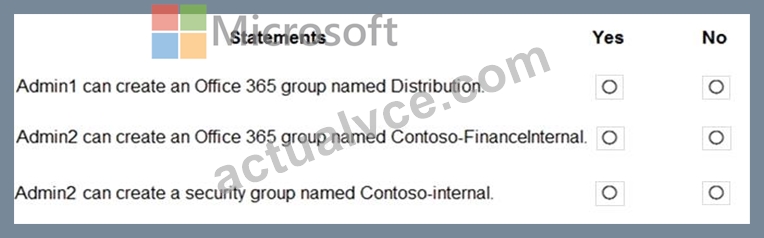
Answer:
Explanation: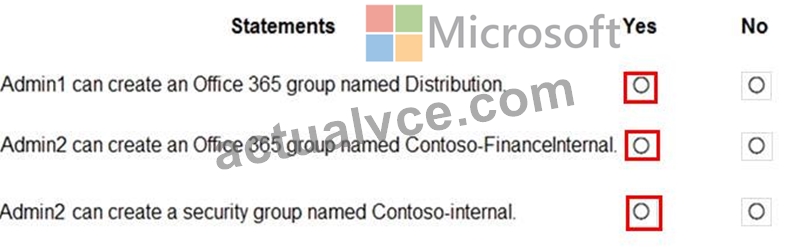
Reference:
https://docs.microsoft.com/en-us/microsoft-365/solutions/groups-naming-policy?view=o365-worldwide
NEW QUESTION 127
You have a Microsoft 365 subscription. From the Security & Compliance admin center, you create the retention policies shown in the following table.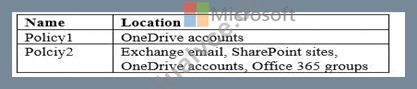
Policy1 if configured as showing in the following exhibit.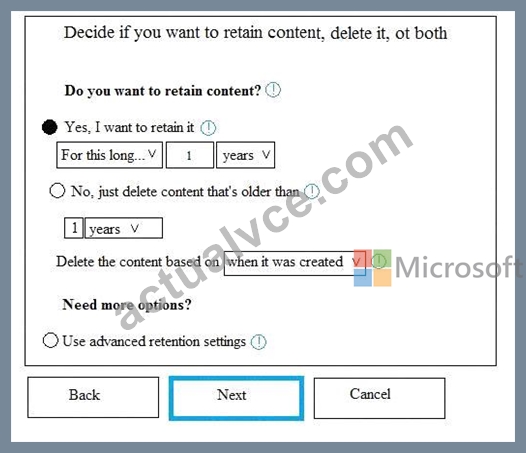
Policy2 is configured as shown in the following exhibit.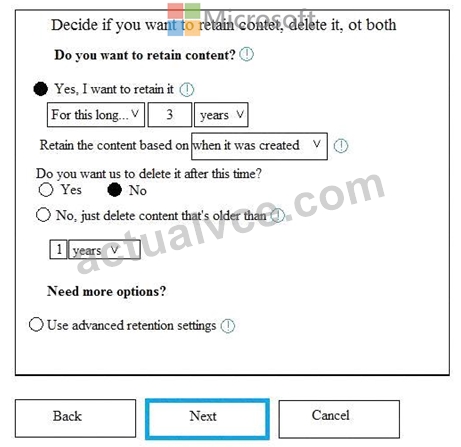
For each of the following statements, select Yes if the statement is true. Otherwise, select No.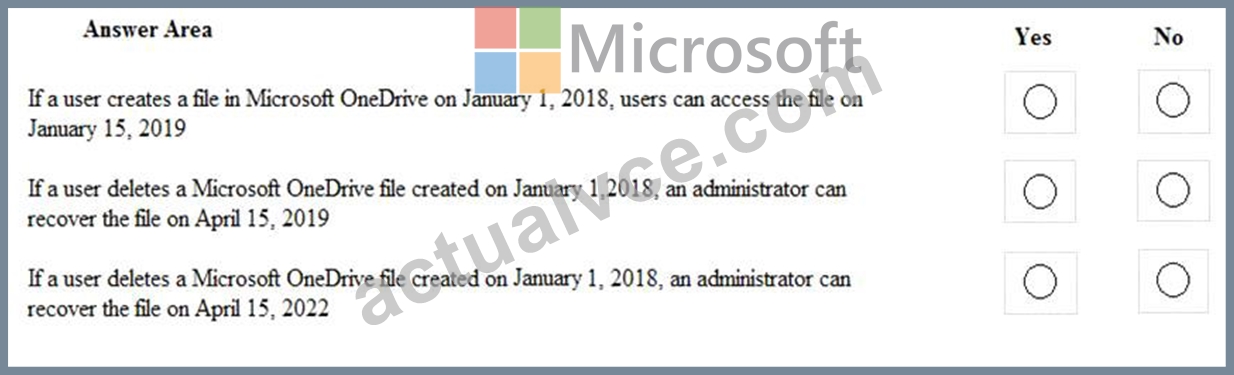
Answer:
Explanation: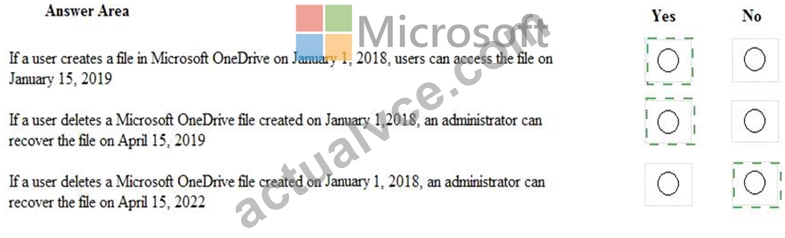
Explanation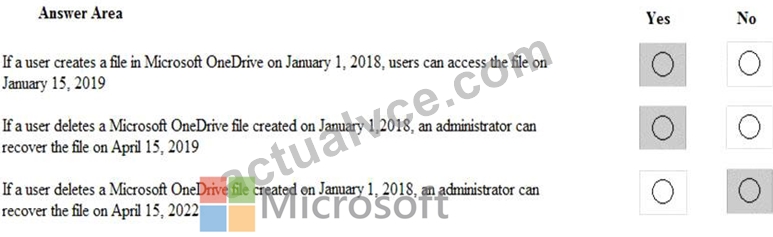
Reference:
https://docs.microsoft.com/en-us/office365/securitycompliance/retention-policies?redirectSourcePath=%252fen-
NEW QUESTION 128
You have a Microsoft Azure Active Directory (Azure AD) tenant named contoso.com that contains the users shown in the following table.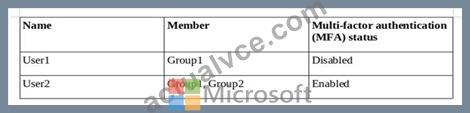
You create and enforce an Azure AD Identity Protection user risk policy that has the following settings:
* Assignments: Include Group1, Exclude Group2
* Conditions: Sign in risk of Low and above
* Access: Allow access, Require password change
You need to identify how the policy affects User1 and User2.
What occurs when User1 and User2 sign in from an unfamiliar location? To answer, select the appropriate options in the answer area.
NOTE: Each correct selection is worth one point.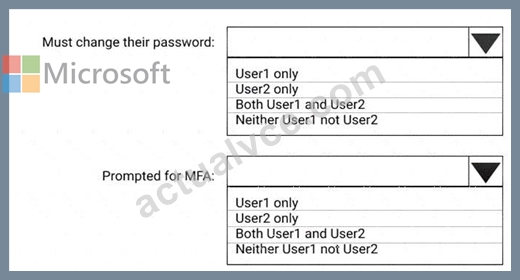
Answer:
Explanation: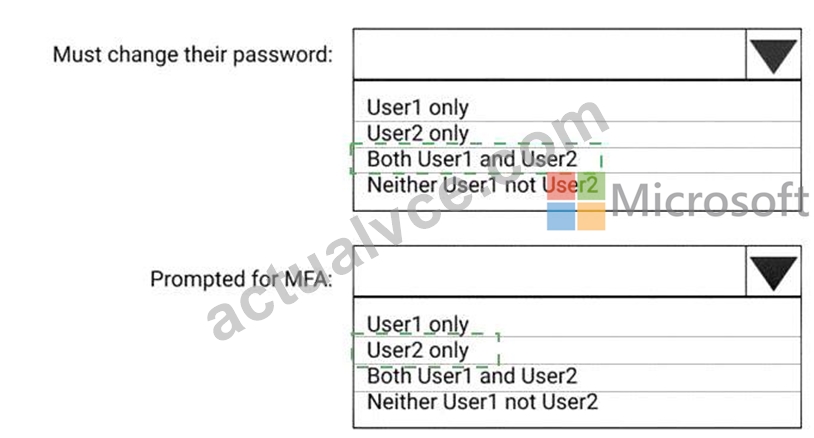
Explanation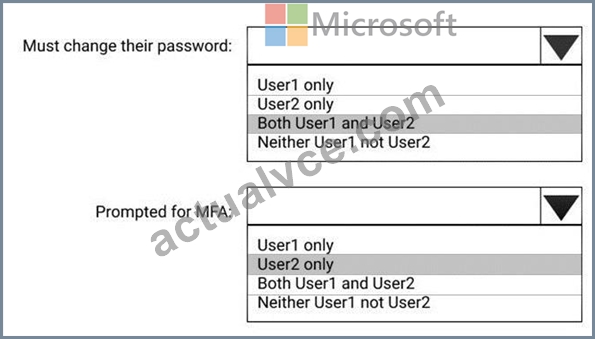
NEW QUESTION 129
You company has a Microsoft 36S E5 subscription and a hybrid Azure active Directory named contoso.com.
Contoso.com includes the following users:
You configure Password protection for Contoso.com as shown in the following exhibit.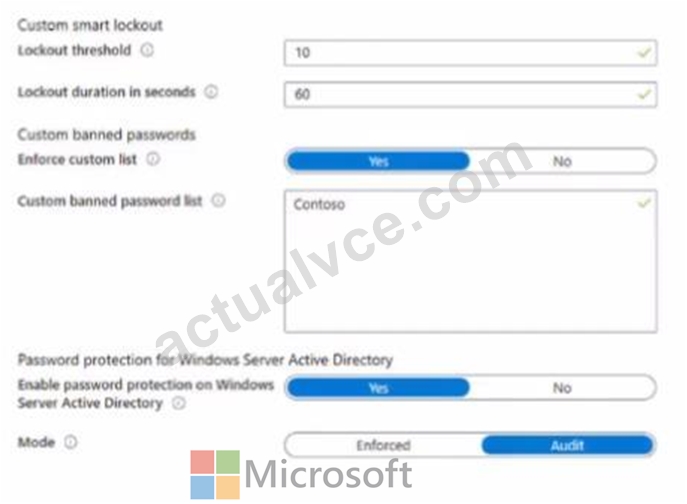

Answer:
Explanation:
NEW QUESTION 130
Note: This question is part of a series of questions that present the same scenario. Each question in the series contains a unique solution that might meet the stated goals. Some questions sets might have more than one correct solution, while others might not have a correct solution.
After you answer a question in this section, you will NOT be able to return to it. As a result, these questions will not appear in the review screen.
You have a Microsoft 365 subscription.
You have a user named User1. Several users have full access to the mailbox of User1.
Some email messages sent to User1 appear to have been read and deleted before the user viewed them.
When you search the audit log in Security & Compliance to identify who signed in to the mailbox of User1, the results are blank.
You need to ensure that you can view future sign-ins to the mailbox of User1.
You run the Set-AuditConfig -Workload Exchange command.
Does that meet the goal?
- A. No
- B. Yes
Answer: A
Explanation:
References:
https://docs.microsoft.com/en-us/powershell/module/exchange/policy-and-compliance-audit/set-auditconfig?view=exchange-ps
NEW QUESTION 131
You have a Microsoft Azure Active Directory (Azure AD) tenant named contoso.com that contains the users shown in the following table.
You create and enforce an Azure AD Identity Protection sign-in risk policy that has the following settings:
* Assignments: Include Group1, Exclude Group2
* Conditions: Sign in risk of Low and above
* Access: Allow access, Require password multi-factor authentication
You need to identify how the policy affects User1 and User2.
What occurs when each user signs in from an anonymous IP address? To answer, select the appropriate options in the answer area.
NOTE: Each correct selection is worth one point.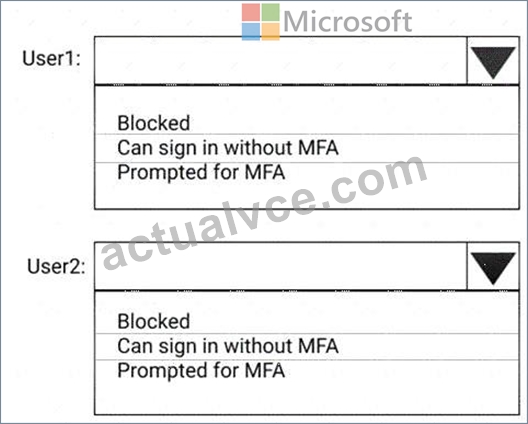
Answer:
Explanation: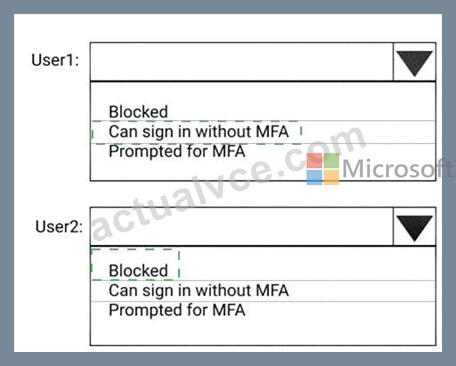
Explanation
NEW QUESTION 132
You have a Microsoft 365 subscription. All users use Microsoft Exchange Online.
Microsoft 365 is configured to use the default policy settings without any custom rules.
You manage message hygiene.
Where are suspicious email messages placed by default? To answer, drag the appropriate location to the correct message types. Each location may be used once, more than once, or not at all. You may need to drag the split bar between panes or scroll to view content.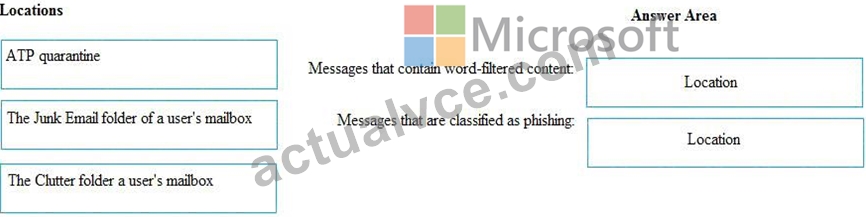
Answer:
Explanation: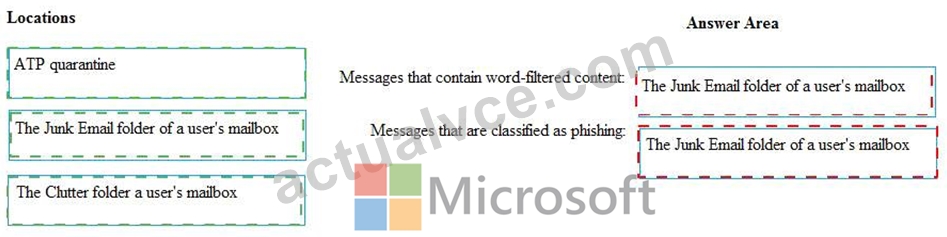
Explanation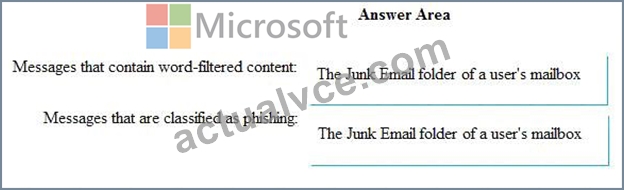
NEW QUESTION 133
You have an Azure Active Directory (Azure AD) tenant named Contoso.com that contains the users shown in the following table.
The User Administrator role is configured in Azure AD Privileged Identity Management (PIM) as shown in the following exhibit.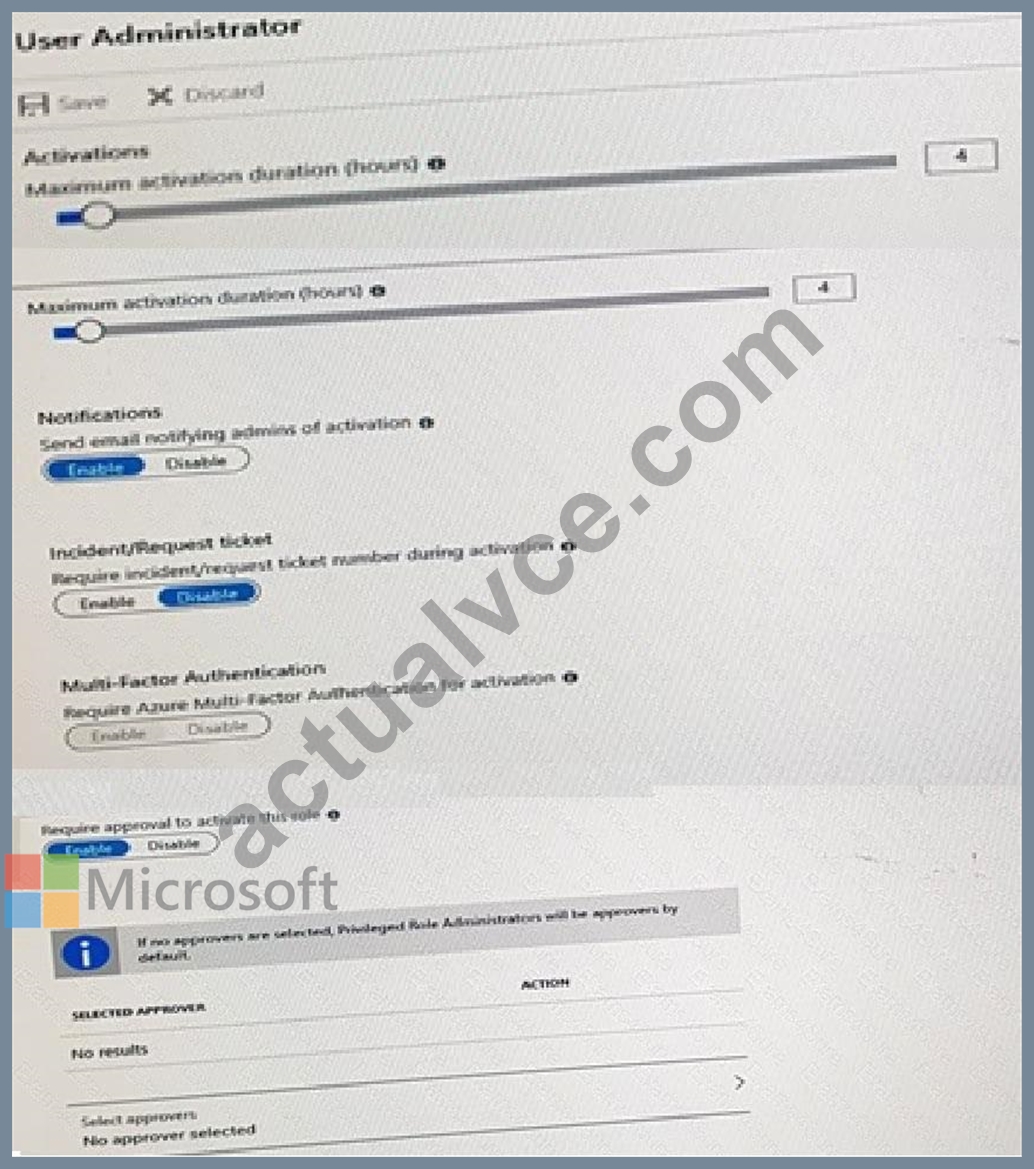
You make User4 eligible for the User Administrator role.
For each of the following statements, Select Yes if the Statement is true. Otherwise, select No./ NOTE: Each correct selection is worth one point.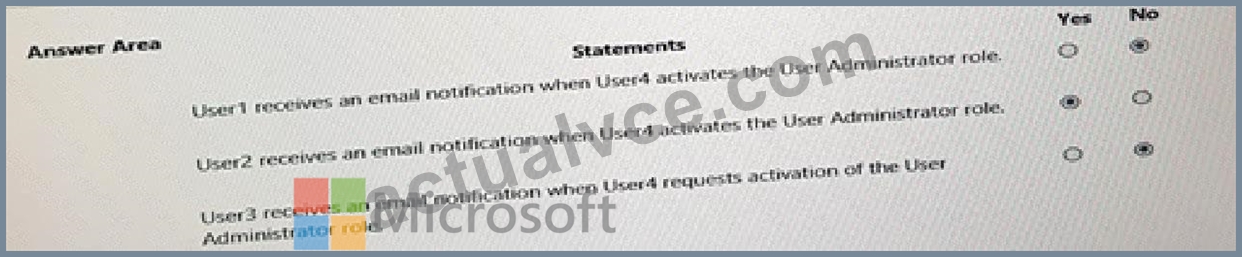
Answer:
Explanation: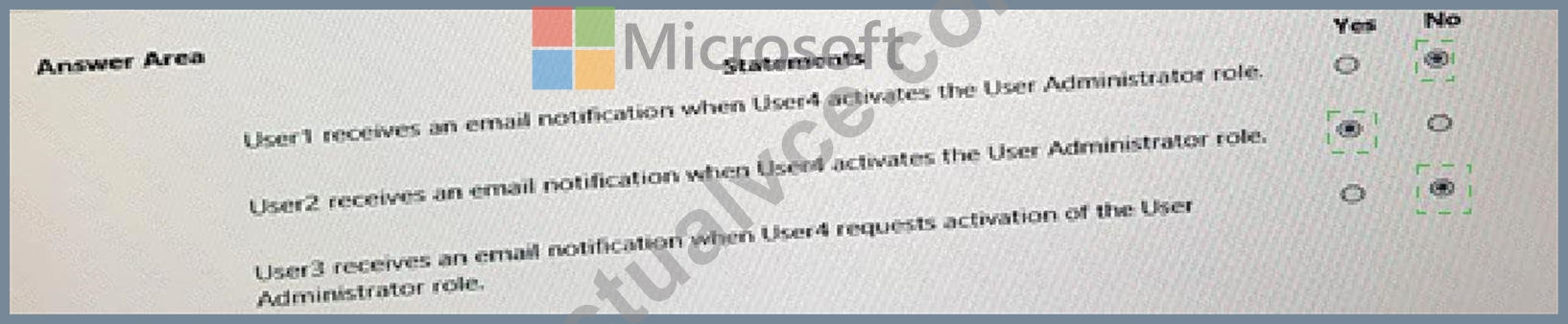
NEW QUESTION 134
You need to create a policy that identifies content in Microsoft OneDrive that contains credit card numbers.
To complete this task, sign in to the Microsoft 365 portal.
Answer:
Explanation:
You need to configure auto-labeling in 'simulation' mode. In the policy, you can select the 'Credit Card' sensitive info type.
* In the Microsoft 365 compliance center, navigate to sensitivity labels:
Solutions > Information protection
* Select the Auto-labeling (preview) tab.
* Select + Create policy.
* For the page Choose info you want this label applied to: Select one of the templates, such as Financial or Privacy. You can refine your search by using the Show options for dropdown. Or, select Custom policy if the templates don't meet your requirements. Select Next.
* For the page Name your auto-labeling policy: Provide a unique name, and optionally a description to help identify the automatically applied label, locations, and conditions that identify the content to label.
* For the page Choose locations where you want to apply the label: Select OneDrive. Then select Next.
* For the Define policy settings page: Keep the default of Find content that contains to define rules that identify content to label across all your selected locations. The rules use conditions that include sensitive information types and sharing options. For sensitive information types, you can select both built-in and custom sensitive information types.
* Then select Next.
* For the Set up rules to define what content is labeled page: Select + Create rule and then select Next.
* On the Create rule page, name and define your rule, using sensitive information types and then select Save.
* Click Next.
* For the Choose a label to auto-apply page: Select + Choose a label, select a label from the Choose a sensitivity label pane, and then select Next.
* For the Decide if you want to run policy simulation now or later page: Select Run policy in simulation mode if you're ready to run the auto-labeling policy now, in simulation mode. Otherwise, select Leave policy turned off. Select Next.
* For the Summary page: Review the configuration of your auto-labeling policy and make any changes that needed, and complete the wizard.
Reference:
https://docs.microsoft.com/en-us/microsoft-365/compliance/apply-sensitivity-label-automatically?view=o365-wo
NEW QUESTION 135
You are evaluating which finance department users will be prompted for Azure MFA credentials.
For each of the following statements, select Yes if the statement is true. Otherwise, select No.
NOTE: Each correct selection is worth one point.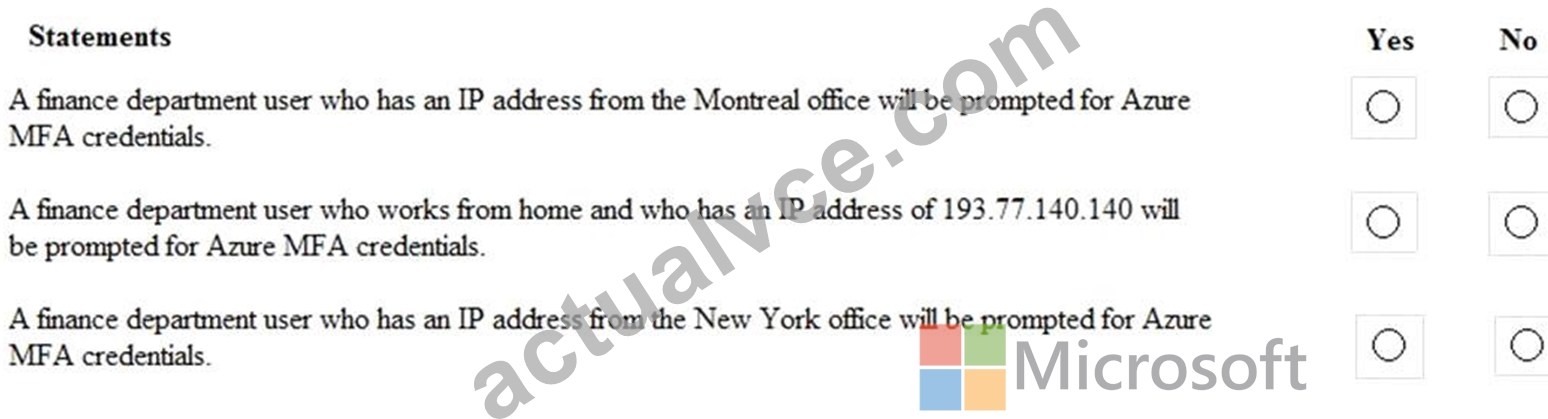
Answer:
Explanation: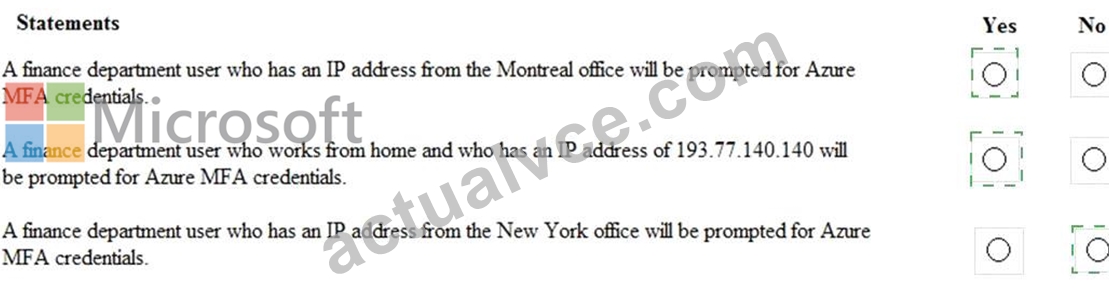
Explanation
YES, YES, NO.
Named locations can't have a private IP range, look at
https://docs.microsoft.com/en-us/azure/active-directory/conditional-access/location-condition
"User IP address The IP address that is used in policy evaluation is the public IP address of the user. For devices on a private network, this IP address is not the client IP of the user's device on the intranet, it is the address used by the network to connect to the public internet."
NEW QUESTION 136
You view Compliance Manager as shown in the following exhibit.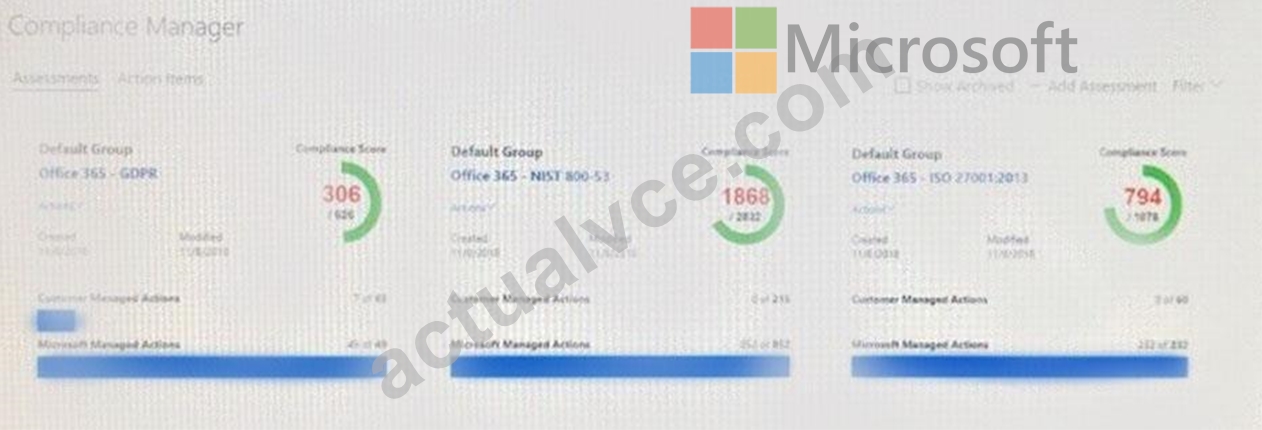
Use the drop-down menus to select the answer choice that completes each statement based on the information presented in the graphic.
NOTE: Each correct selection is worth one point.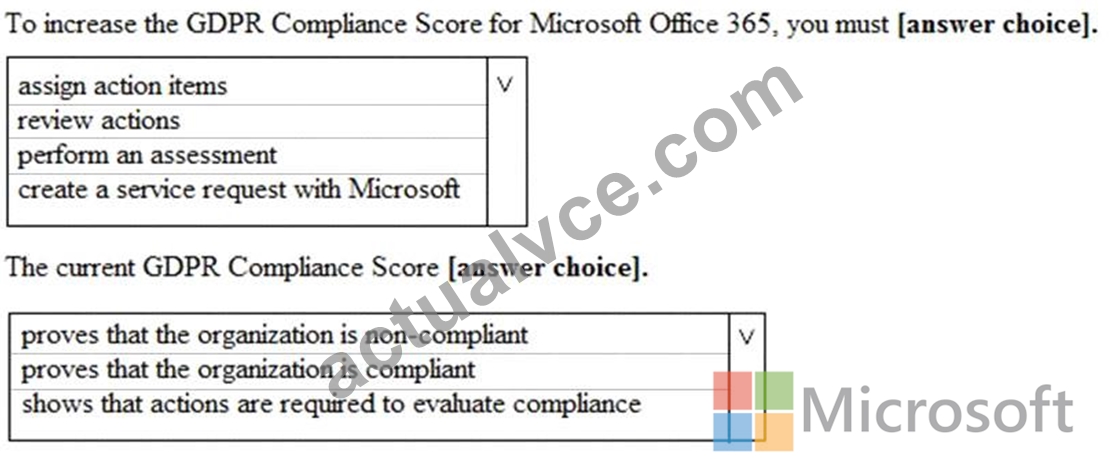
Answer:
Explanation: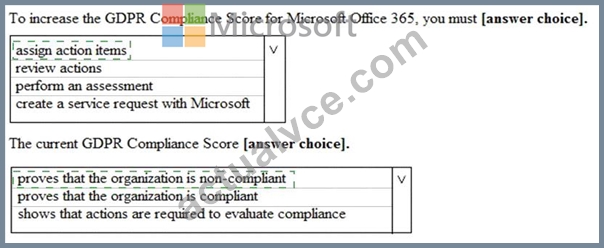
Explanation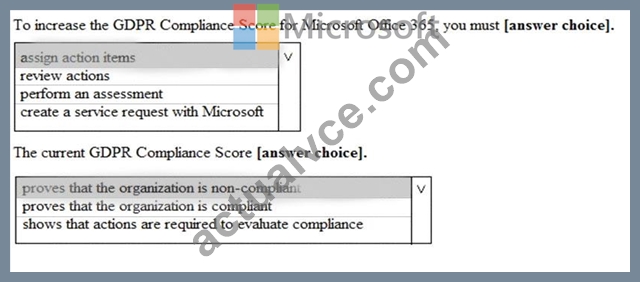
Reference:
https://docs.microsoft.com/en-us/office365/securitycompliance/meet-data-protection-and-regulatory-reqs-using-m
NEW QUESTION 137
Please wait while the virtual machine loads. Once loaded, you may proceed to the lab section. This may take a few minutes, and the wait time will not be deducted from your overall test time.
When the Next button is available, click it to access the lab section. In this section, you will perform a set of tasks in a live environment. While most functionality will be available to you as it would be in a live environment, some functionality (e.g., copy and paste, ability to navigate to external websites) will not be possible by design.
Scoring is based on the outcome of performing the tasks stated in the lab. In other words, it doesn't matter how you accomplish the task, if you successfully perform it, you will earn credit for that task.
Labs are not timed separately, and this exam may more than one lab that you must complete. You can use as much time as you would like to complete each lab. But, you should manage your time appropriately to ensure that you are able to complete the lab(s) and all other sections of the exam in the time provided.
Please note that once you submit your work by clicking the Next button within a lab, you will NOT be able to return to the lab.
Username and password
Use the following login credentials as needed:
To enter your username, place your cursor in the Sign in box and click on the username below.
To enter your password, place your cursor in the Enter password box and click on the password below.
Microsoft 365 Username:
admin@[email protected]
Microsoft 365 Password: #HSP.ug?$p6un
If the Microsoft 365 portal does not load successfully in the browser, press CTRL-K to reload the portal in a new browser tab.
The following information is for technical support only:
Lab instance: 11122308
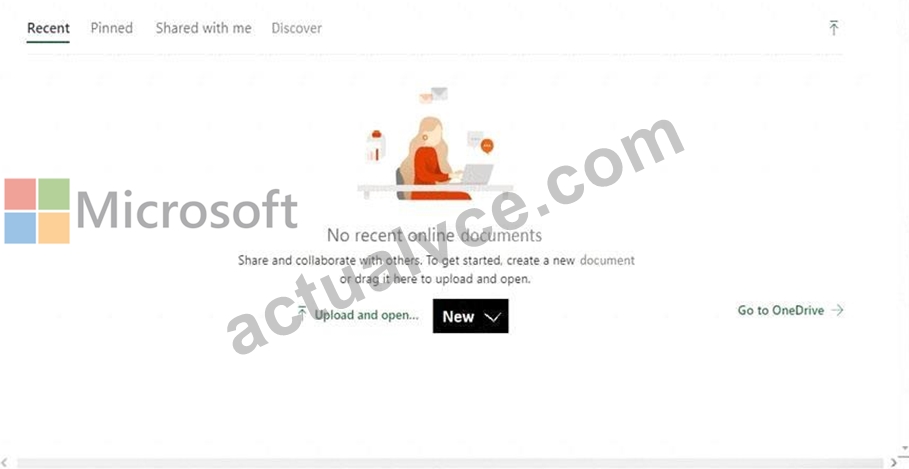
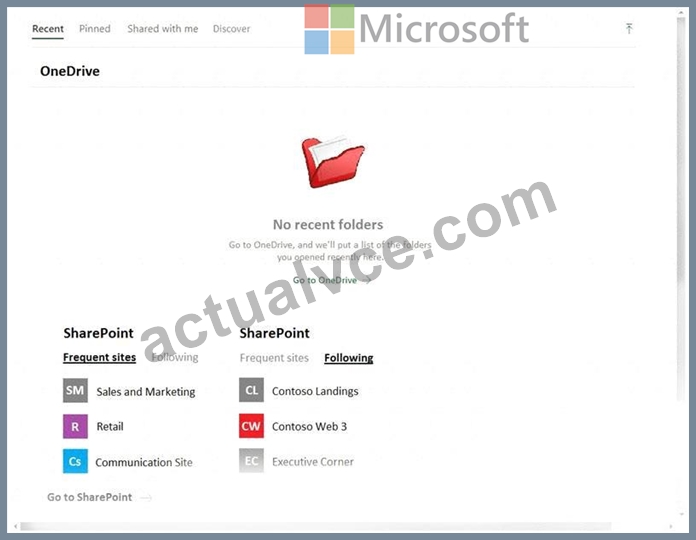
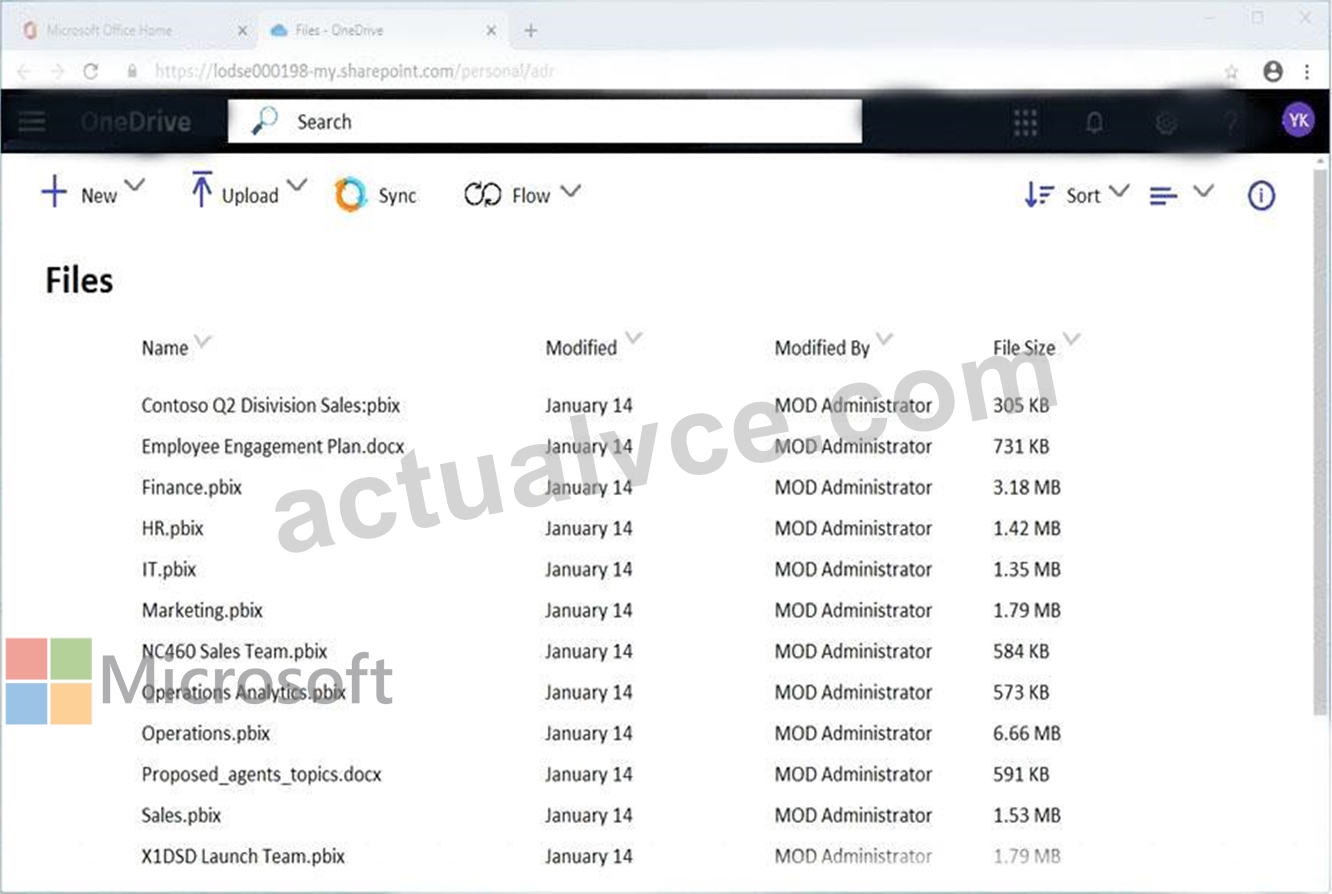
You need to create a retention policy that contains a data label. The policy must delete all Microsoft Office
365 content that is older than six months.
To complete this task, sign in to the Microsoft 365 admin center.
Answer:
Explanation:
See explanation below.
Explanation
Creating Office 356 labels is a two-step process. The first step is to create the actual label which includes the name, description, retention policy, and classifying the content as a record. Once this is completed, the second step requires the deployment of a label using a labelling policy which specifies the specific location to publish and applying the label automatically.
To create an Office 365 label, following these steps:
1. Open Security and Compliance Centre;
2. Click on Classifications;
3. Click on Labels;
4. The label will require configuration including: name your label (Name), add a description for the admins ( Description for Admins), add a description for the users (Description for Users);
5. Click Next once the configuration is completed;
6. Click Label Settings on the left-hand side menu;
7. The Label Settings will need to be configured. On this screen, you can toggle the Retention switch to either
"on" or "off". If you choose "on", then you can answer the question "When this label is applied to content" with one of two options. The first option is to . From the pick boxes, you can choose the length of retention and upon the end of the retention, the action that will take place. The three actions are to delete the data, trigger an approval flow for review, or nothing can be actioned. The second option is to not retain the data after a specified amount of time or based on the age of the data; and
8. The label has now been created.
To create a label policy, follow these steps:
1. Open Security and Compliance Centre
2. Click on Data Governance, Retention
3. Choose Label Policies box at the top of the screen; and
4. There are now two options. The first is to . If your organization wants its end users to apply the label manually, then this is the option you would choose. Note that this is location based. The second option is to Auto-apply Labels. With Auto-apply, you would have the ability to automatically apply a label when it meets the specified criteria.
References:
https://www.maadarani.com/office-365-classification-and-retention-labels/
NEW QUESTION 138
You have a Microsoft 365 subscription that uses an Azure Active Directory (Azure AD) tenant named contoso.com. All the devices in the tenant are managed by using Microsoft Intune.
You purchase a cloud app named App1 that supports session controls.
You need to ensure that access to App can be reviewed in real time.
Which three actions should you perform in sequence? To answer, move the appropriate actions from the list of actions to the answer area and arrange them in the correct order.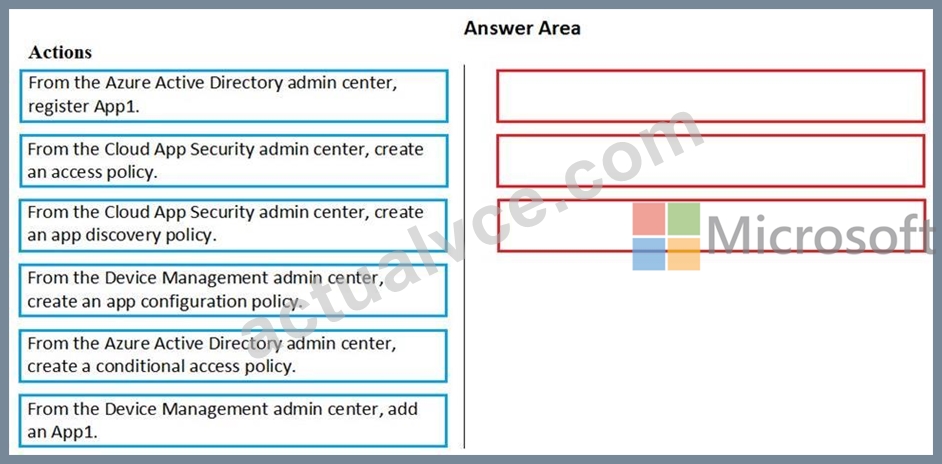
Answer:
Explanation:
Explanation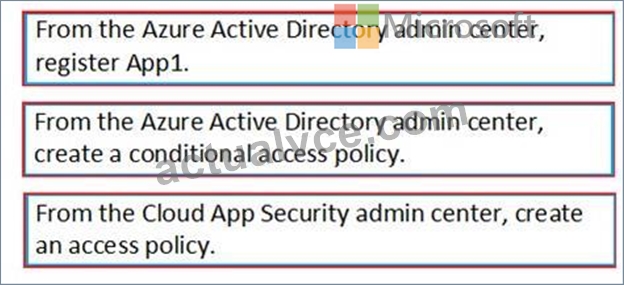
References:
https://docs.microsoft.com/en-us/cloud-app-security/access-policy-aad
NEW QUESTION 139
......
MS-500 dumps - ActualVCE - 100% Passing Guarantee: https://www.actualvce.com/Microsoft/MS-500-valid-vce-dumps.html
Fast, Hands-On MS-500 exam: https://drive.google.com/open?id=199S5O6s5qARpzQmApQTUielj6In1CbIk